

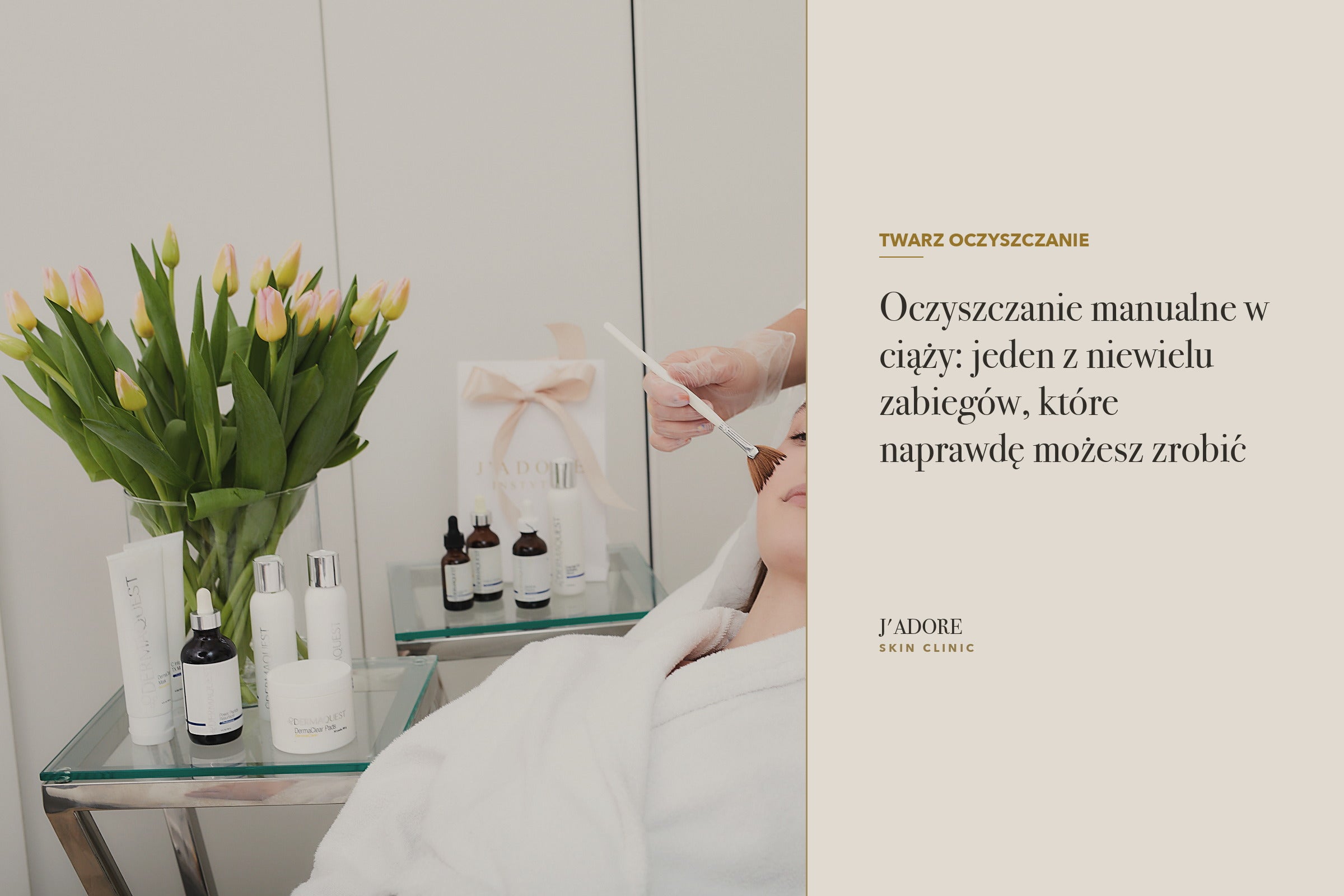
Pregnancy takes away many cosmetic treatments. Manual cleansing is one of those that remain — and it's worth knowing why.
Skin during pregnancy behaves unpredictably. For some women it has never looked better — moisturised, radiant, without a trace of imperfections. For others, the first weeks bring back teenage acne: blackheads, pimples, oily zones and skin that does not respond to anything from the old skincare routine. Between these two poles there are many shades — and almost all of them stem from the same thing: sudden hormonal changes that remodel the functioning of sebaceous glands and the rate of keratinization. Manual cleansing is one of the few cosmetic treatments that can be performed safely during pregnancy and that truly responds to these changes. The problem is that it is surrounded by so many myths — "it hurts," "it causes infections," "why bother during pregnancy" — that many women give up in advance. We are taking it on.
Why a pregnant woman's skin requires a different approach
Progesterone and oestrogens are hormones that during pregnancy reach levels incomparable to any other moment in a woman's life. For the skin this means primarily two things. First of all — the sebaceous glands work at a higher rate. More sebum means more nutrients for bacteria and more clogged pores. For women who have never struggled with acne before, this may be their first encounter with blackheads at all — and quite a surprise. Secondly — the rate of keratinization accelerates. Dead epidermal cells accumulate faster than the skin is able to remove them on its own, pores become clogged, and typical home care products stop being enough.
The popular "pregnancy glow" is the effect of increased blood flow through the skin and higher hydration — not every pregnant woman experiences it. "Pregnancy acne," in turn, is thanks to androgens that stimulate the sebaceous glands: the same mechanism works during puberty, but in pregnancy far more variables overlap with it. Both things can be true — in the same woman, in different trimesters.
On top of that comes the higher skin pH during pregnancy, changes in the microbiome, swelling and — in some women — increased sensitivity. The skin is literally in a different biological mode. A skincare routine that worked for years often stops being effective. And here comes the question we hear in the clinic very often: what else can be done?
The banned list — and why manual cleansing isn't on it
Pregnancy rules out a large part of what modern cosmetology offers. Not because doctors are overly cautious, but because with many methods they simply clinical data are lacking confirming safety for the fetus — and the principle "better not, when we don't know" is reasonable here. The list of most frequently mentioned limitations:
- Chemical peels — especially higher concentrations of acids (e.g. TCA, salicylic acid at high concentrations) are absorbed through the skin, and some of them can penetrate into the bloodstream.
- Needle mesotherapy and platelet-rich plasma — no clinical studies on pregnant women.
- Laser treatments and high-intensity light therapy — risk of tissue overheating and unknown systemic effects.
- Botox and fillers — substances administered by injection, with no established safety protocols in pregnancy.
- Laser hair removal — not recommended due to hormonal skin changes and sensitivity.
- Retinol and vitamin A in high concentrations — both applied topically in large amounts and oral isotretinoin are absolutely contraindicated.
Manual cleansing has no place among them — and not for lack of interest, but because it is a purely mechanical treatment performed on the surface of the skin, without systemically absorbed substances and without energy (laser, heat, ultrasound) that could reach deeper. The cosmetologist works with their hands, a lancet, or a Volkmann spoon on the epidermis — and that is where its strength lies in the context of pregnancy: it is precise, local, and fully controlled.
Before any treatment during pregnancy — even a classic cleansing — it is worth informing the cosmetologist about the week of pregnancy and current health status. Not all substances used during the treatment (masks, ampoules, tonics) are automatically safe. A professional salon will adjust the composition of the preparations to the state of pregnancy. In case of doubt — consult your gynecologist.
Seven myths about cleansing during pregnancy
Myth 1: "Cleansing hurts, so even more so during pregnancy". The perception of pain is subjectively higher during pregnancy — that is true. But pain during manual cleansing does not result from the method itself, but from depth and number of blackheads, skin firmness and the cosmetologist's technique. Well-prepared, steamed skin and gentle, precise extraction may be noticeable, but does not have to be painful. A cosmetologist working with a pregnant woman adjusts the pressure and pace to the skin's current tolerance — and responds to feedback on an ongoing basis. The myth of unbearable pain most often comes from experiences with poorly prepared skin or a rushed treatment.
Myth 2: "After cleansing the skin looks worse because it's red". Redness after the treatment is normal effect of local tissue irritation — not damage and not an alarm signal. In pregnant women, blood vessels are more reactive (higher blood flow through the skin), so redness may be more pronounced and last slightly longer than usual. It usually subsides within a few to a dozen or so hours. A well-timed treatment done in the morning gives time for the skin to calm down before the evening. After the treatment, the cosmetologist applies a soothing mask and a suitable cream — this shortens the duration of redness.
Myth 3: "Cleansing spreads bacteria and causes infections". This is a possible scenario — but only with improper technique and lack of disinfection. In a professional salon, tools are sterile or single-use, the skin is disinfected before and after extraction, and the cosmetologist's technique minimizes the transfer of contents between pores. At-home "squeezing" is something else — there the risk increases, because there is no sterility, no knowledge of the depth of the blackhead, and no appropriate pressure. The myth conflates two completely different contexts: the salon versus the bathroom.
Myth 4: "Cleansing permanently enlarges pores". This is one of the most enduring cosmetic legends — and one of the most untrue. Pore size depends on genetics, skin thickness, surrounding collagen tension and the amount of accumulated sebum. Manual cleansing removes the contents of the pore — which makes it look more visible for a moment (because it is emptied and relaxed). But it does not stretch it permanently. On the contrary: regularly cleansed skin with healthy sebum metabolism less often forms blockages that mechanically stretch the gland's opening. Pores "enlarged after cleansing" are an optical and temporary effect.
Pores are largest where sebum is produced most intensively — the nose, chin, center of the forehead. This is not the result of earlier treatments, but of the density of sebaceous glands in this zone, which is genetically determined. Cleansing them does not create or enlarge them — it merely becomes necessary for them more often precisely because of this density.
Myth 5: "During pregnancy the skin clears up on its own anyway — hormones take care of it". A popular view that confuses "pregnancy glow" with a lack of need for care. In women whose skin reacts to hormones with overproduction of sebum, it is exactly the opposite — the skin needs more support than usual, no less. Blackheads and micro-inflammations don't disappear on their own just because you're pregnant. Without regular cleansing, they can accumulate and lead to permanent changes — enlarged pores, post-inflammatory hyperpigmentation, and in some women, deeper inflammatory conditions that are harder to treat during pregnancy than outside of it.
Myth 6: "After childbirth everything returns to normal anyway, so it's not worth investing". Some skin changes in pregnancy do indeed resolve after childbirth and the end of breastfeeding — but not all of them and not automatically. Post-inflammatory hyperpigmentation after pregnancy acne, they can persist for months. Enlarged pores after prolonged sebum retention, they do not close on their own. The habit of neglecting the skin during pregnancy it easily carries over into the first months after childbirth — and that is the time when the skin has a double backlog to make up for. Regular care during pregnancy is simply cheaper than treating its effects afterwards.
Myth 7: "It's not a good moment for a treatment — it's stress for the body". Manual cleansing performed by an experienced cosmetologist is one of the least stressful treatments available in the clinic. It does not require anesthesia, does not engage the circulatory or nervous system in any specific way, and does not require recovery. In the first trimester — especially with nausea and high sensitivity — it is worth waiting until you feel better. The second trimester is the classic "golden mean": the body is usually more stable, and the skin is only just beginning to react to hormonal changes. The third trimester is a matter of comfort of the position in the chair, but cleansing itself is not contraindicated.
Pregnancy should be mentioned at the beginning of the visit, not after the fact. A good cosmetologist will adjust: the choice of products (no retinol, no high concentrations of acids, no potentially allergenic substances), the position in the chair (after the 20th week we avoid lying flat on the back — the backrest can be tilted), the intensity of massage and steaming, and the composition of the mask after the treatment.
What cleansing tailored to pregnancy looks like
A manual cleansing treatment during pregnancy follows the same logic as outside of it — but with a few important modifications. It is not about simplification, but about adapting each step to the altered physiology of the skin and to the safety of mother and child.
Makeup removal with products safe during pregnancy (without excess essential oils, without alcohol in high concentrations). The cosmetologist assesses the skin's condition — the type of blackheads, zones, sebum level, sensitivity.
Classic steam steaming is safe; the intensity and duration are adjusted so as not to overheat — a pregnant woman's body temperature reacts more strongly to external heat. Alternatively: warm compresses.
An exfoliating preparation suitable for pregnancy: enzymatic (papain, bromelain) or a gentle physical peel. No salicylic acid in high concentrations, no retinol, no AHA in a concentration exceeding the safe minimum.
Cleansing pores of blackheads and micro-inflammations. Sterile tools, disinfection. Precision and gentleness are the priority — without excessive pressure and without working in areas where the skin is clearly irritated or the inflammation is deep.
Alcohol-free tonic without substances that are potentially systemically absorbed. Pore tightening, restoration of the skin's pH.
A mask based on aloe, panthenol, thermal water, or ingredients with a soothing and regenerating effect. Without substances with strong biological action (e.g., niacinamide in high concentrations in the first trimester — use with caution).
Moisture and protection. The selection of the composition tailored to the current condition of the skin — oily or combination skin is handled differently than dehydrated skin (and this is surprisingly common with pregnancy-related changes in the lipid barrier).
Important rule: the cosmetologist selects preparations after information about pregnancy, not before. The list of ingredients worth avoiding during pregnancy is long and changes depending on the trimester — a professional salon should have this knowledge and not require the client to come with her own list of forbidden substances.


When cleansing is particularly indicated — and when it is worth waiting
- Second trimester — well-being usually more stable, the skin begins to react to hormones
- Visible intensification of blackheads and clogged pores
- Oily or combination skin with a tendency to inflammation
- Regular home care is no longer enough
- First consultation visit before setting a pregnancy skincare plan
- First trimester with severe nausea and high heat sensitivity
- Active, deep inflammatory or cystic acne — requires a doctor's consultation
- Highly reactive skin with allergic symptoms during pregnancy
- Pre- and post-operative state (e.g. after cervical correction, in high-risk pregnancy)
- Exacerbation of skin conditions such as rosacea or atopic dermatitis
Manual cleansing is one of the few treatments that can be performed in all trimesters of pregnancy — but always after an individual assessment of the skin condition and the health of the pregnant woman. If the pregnancy is complicated or the doctor has advised limiting activity, consult every cosmetic treatment, even a classic one.
Between visits — home care that supports, not harms
A manual cleansing treatment works best when it is regular and supported by appropriate home care. During pregnancy this rule is doubly important — the skin changes from week to week and the routine from before pregnancy often needs revising. A few rules that we often repeat:
- Washing your face twice a day — morning and evening. No more, because excessive cleansing disrupts the hydrolipidic barrier, which paradoxically increases sebum production.
- Alcohol-free tonic — denatured alcohol dries out the epidermis and is unnecessary with a well-chosen soap/gel.
- Moisturizing even oily skin — dehydration of oily skin is one of the most common mistakes; skipping cream on "shiny" skin intensifies the activity of the sebaceous glands.
- SPF every day — a pregnant woman's skin is more prone to hyperpigmentation (melasma of pregnancy). A physical filter (zinc oxide, titanium dioxide) is safe during pregnancy.
- Avoid aggressive squeezing — at-home cleansing without sterile tools and knowledge of the blackhead depth increases the risk of infection and scarring far more than not cleansing at all.
- Consult new ingredients with a cosmetologist or gynecologist — retinol, salicylic acid in higher concentrations and strong exfoliating acids should be postponed until after childbirth and the end of breastfeeding.
It's six in the morning, your belly has long since shifted its center of gravity, and the bathroom mirror shows skin tired from a night spent on your side. Cleansing gel, toner, cream with SPF — three steps that take four minutes and cost less energy than worrying about what you see. Pregnancy skincare doesn't have to be complicated to be effective. It has to be consistent and matched to what your skin really needs now — not to what it needed a year ago.
What remains after pregnancy — and what to do about it
Hyperpigmentation, enlarged pores, changes in hydration and lipid barrier — skin after pregnancy and after finishing breastfeeding can be a surprise even for women who coped well during pregnancy. This is the time when you can return to the full range of cosmetological methods and make up for what was postponed for over a dozen months.
Regular manual cleansing during pregnancy is also investment in the starting point: skin that has been regularly cleansed and supported over those dozen or so months requires less intensive treatment of changes after childbirth and less time to return to good condition. This is not a cosmetic whim — it is an element of long-term care.
Don't know where to start?
Book a consultation at J'ADORE INSTYTUT — we will match the care and treatments to your skin.
See productsBook a consultationEducational information. The article is educational in nature and does not constitute medical or cosmetological advice. Every pregnancy is different — before undergoing any cosmetic treatment during pregnancy, consult your attending gynecologist and inform the cosmetologist about your pregnancy and current trimester. J'adore Instytut — Warsaw (Żelazna 59, Mińska 29) and Kraków (Karmelicka 45A).


