

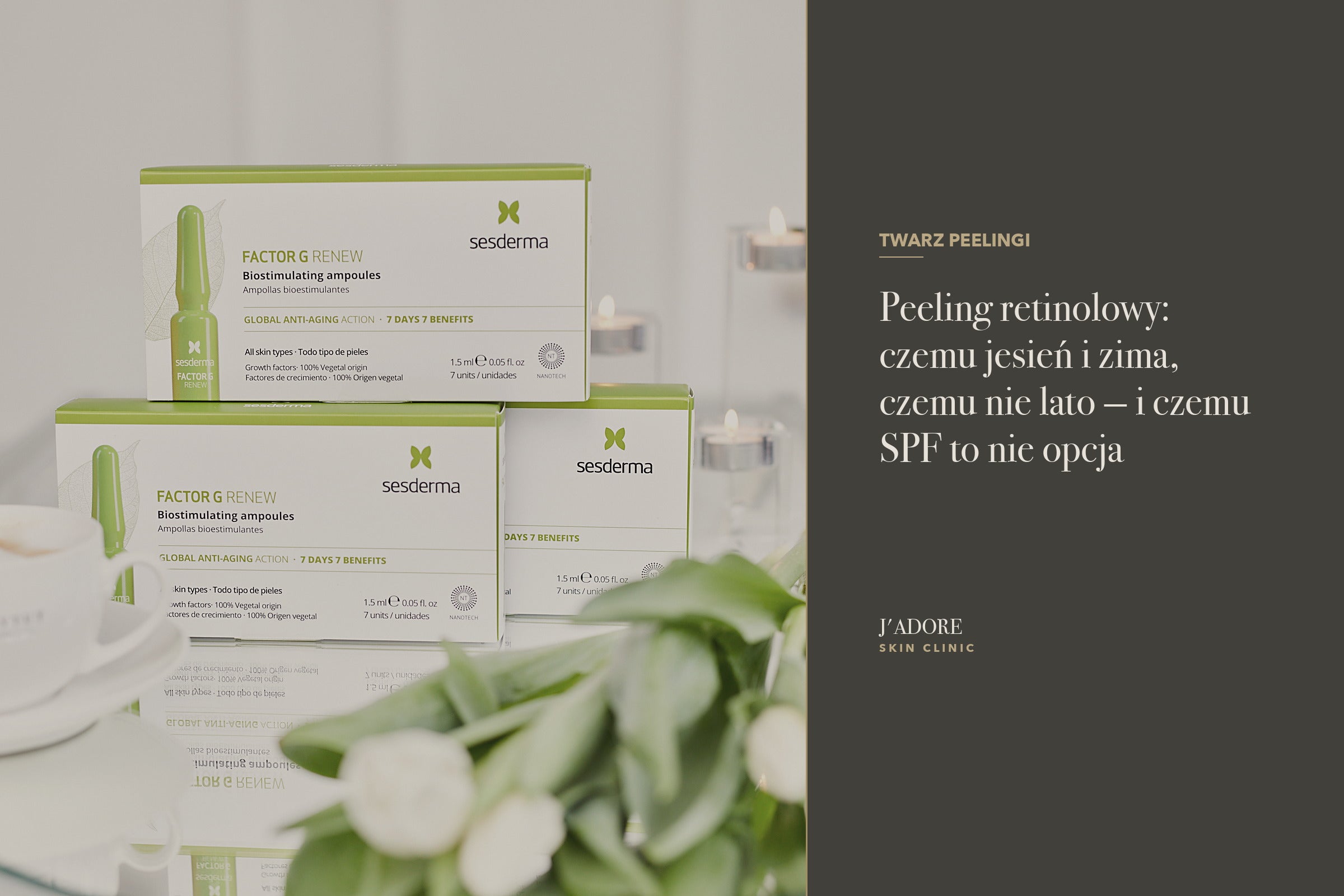
Retinol and sun are a combination that costs the skin more than it gains. We explain why — and how to get the full potential out of peels.
A retinol peel is one of those treatments around which a surprisingly large number of simplifications have grown — even though the mechanism of retinol's action is exceptionally well described in dermatological literature. In summer, in winter, before a holiday, after a holiday — we hear various versions, some of which can really end in a problem. It's not about scaring anyone: it's about the fact that retinol and UV radiation act on the skin in exactly opposite directions, and ignoring this rule nullifies the effects of the treatment and at the same time increases the risk of hyperpigmentation. We break down the myths into first principles — what is true, what is a simplification, and what is simply a mistake.
Where the myth "you can use retinol all year round" comes from
Some of the misunderstandings come from combining different forms of retinol into one category. Retinol in pharmacy creams, retinol in serums, prescription tretinoin, and professional retinol peels performed in a clinic are treated as the same thing — yet there is a fundamental qualitative difference between home and clinical concentrations. The second reason: home care information is copied into the context of in-clinic treatments, where concentrations, depth of action, and skin response are incomparably greater.
On top of that pressure of the holiday season: we like to go on holiday with good skin, we want a quick effect, the salon is nearby and has an available appointment — so we book it. The result? Skin after an intensive retinol treatment exposed to July sun. It's not a matter of bad will, it's a matter of incomplete information.
Retinol is a derivative of vitamin A — a substance described in dermatology for over fifty years. For years it was the domain of dermatologists and prescriptions. Today, in appropriate concentrations and forms, it is widely available — which is good, but at the same time blurs the line between "use" and "treatment".
Myth 1: "A retinol peel can be done in summer"
This is not just a myth — it is one of the most common mistakes, one that really does end in a dermatological problem. Retinol accelerates cellular turnover and exfoliation of the epidermis: the new skin that comes to the surface after the treatment is much thinner, devoid of the "usual" protective layer and several times more sensitive to UV radiation than skin that has undergone a full natural renewal cycle.
Combining exfoliated skin with summer sun is a simple path to post-inflammatory hyperpigmentation, which can persist for months and require later treatment — perversely, also often with the use of retinol. In addition, heat, sweating, and outdoor activity increase the risk of irritation of skin that, even without sun, is in a state of regeneration after the treatment.
When irritated or sensitised skin comes into contact with UV radiation, melanocytes react with an overproduction of pigment in response to the inflammatory state. The result is dark, irregular hyperpigmentation — difficult to treat, because it lies deeper than an ordinary tan. It is the opposite of what most people going for a retinol peel are looking for.
Myth 2: "There's no sun in winter, so SPF is unnecessary"
It is one of the most costly oversimplifications in skin care. UVA radiation — the one responsible for skin aging and discoloration — penetrates through clouds, window glass and does not disappear in winter. Its intensity is lower than in summer, but for skin after a retinol treatment, "lower" still means "enough to cause harm."
In the salon, we ask about the use of sunscreen not because it's a formal procedure — but because without SPF, the effects of peels not only diminish but can reverse. Retinol works on new, fresh skin. Without a filter, the same skin is exposed to the same radiation that reverted it to its initial state.
UVB radiation (the "burning" sun) is stopped by glass. UVA radiation — is not. People who spend a lot of time in a car or at a desk by a window often have more visible hyperpigmentation on the side of the face closer to the glass. Sunscreen works both ways.
Using SPF 30–50+ sunscreen for a minimum of 4–6 weeks after a series of retinol treatments is not an optional recommendation — it is a condition of safety and efficacy. Dermatologically justified in both July and December.
Why autumn and winter are the optimal time
The autumn-winter season is structurally better for retinol peels for several reasons — this is not an excuse, it is physics and biology. First of all — less sun and fewer hours of UV exposure reduces the risk of hyperpigmentation almost automatically. Secondly — cool air reduces sweating and skin irritation during regeneration. Third — with gray, dry skin after summer the renewal effects are clearly visible: evened-out skin tone, better texture and better hydration noticeable a few weeks after the series of treatments.
The perfect entry into the season: skin after summer needs regeneration, UV intensity drops significantly, and you can start a series of treatments.
Mid-season: a series of treatments in progress, the skin is renewing itself; SPF is mandatory even on cloudy days and by a window.
Finishing and consolidating the effects before the sun season rebuild; a good moment for moisturizing and biostimulating treatments as a complement.
A break or planning the next series; the skin is ready for summer — but from now on, SPF every day, not just at the beach.
This does not mean that in summer the skin does not need care — it does, just different procedures. Gentle enzymatic peels, deep hydration, treatments that strengthen the skin's protective barrier and, of course, constant sunscreen are a summer protocol that does not conflict with the season. Retinol waits until autumn and benefits from it.
Myth 3: "One treatment is enough for the whole summer"
Retinol peel do not "reset" the skin once and for all — it is a regenerative treatment whose effects last for a time proportional to the depth of the treatment and the condition of the skin. Most people feel a clear improvement after a series of several treatments at seasonal intervals — but without UV protection for the rest of the year, these effects simply reverse. The sun destroys collagen, generates free radicals and activates melanocytes regardless of what you had done in the clinic three months earlier.
Hence the logic seasonal approach to peels — one series in autumn, possibly a top-up in winter, protection and maintenance in spring. This is not a scheme invented by clinics, it is a response to the biological rhythm of the skin and the annual cycle of UV exposure. Anyone who treats a peel as a one-off treatment and then goes back to summer holidays without SPF is building on sand.
Retinol is photosensitizing — not only the skin after the treatment, but also the active ingredient itself decomposes faster under the influence of UV. In winter, both the skin and the active substance can work in optimal conditions: less light, lower temperatures, higher durability of the formula. This is one of the reasons why home preparations with retinol are recommended to be used in the evening, not in the morning.
Myth 4: "A retinol peel is only for women with hyperpigmentation"
A retinol peel is sometimes associated with a niche "for hyperpigmentation" procedure — and that is definitely too narrow a perspective. Retinol stimulates collagen synthesis, accelerates cell renewal and evens out skin texture, which translates into many different indications: hyperpigmentation is one of them, but just as often the goal is to smooth fine wrinkles, improve the color of gray, tired skin, or regulate sebum secretion in oily and acne-prone skin.
Indications in men can be slightly different — denser and more sebaceous skin reacts to retinol differently than female skin; redness and peeling may be stronger in the first stage of the series, but the effects on texture and sebum regulation are often very pronounced. The season is the same as for women: autumn and winter, with sunscreen as a must.
- Sun-induced and hormonal hyperpigmentation
- Fine wrinkles and loss of firmness
- Dull, tired complexion after summer
- Evening out of skin tone and texture
- Seborrhea and skin prone to blackheads
- Uneven texture and enlarged pores
- Expression wrinkles and photodynamic aging
- Reinitiation of color after excessive UV exposure


Myth 5: "Every retinol peel is the same"
"I'll order retinol from the pharmacy and it's the same thing" — no, it's not. Concentration, chemical form and carrier of the active substance they determine how deeply it works and how intense the skin's reaction is. In an in-clinic retinol peel, the concentration and depth of action are incomparably higher than in OTC products — and that is precisely why it requires a different post-treatment care protocol, proper skin preparation and, above all, different attention to sun protection.
In the salon, they also assess skin condition before the treatment — active rosacea, fresh inflammatory lesions, very dry skin and a damaged barrier can be temporary contraindications. This isn't scaremongering — it's simply about making sure the treatment actually brings results rather than aggravating the problem. That's why a series of treatments starts with a consultation, not with the first appointment.
A few days before a retinol peel, it's worth limiting at-home use of acids (AHA, BHA) and retinol in creams — so that the skin doesn't go into the treatment in a state of excessive exfoliation. We'll tell you exactly about this during the consultation — the protocol is short and simple to maintain.
How not to lose the results — rules that matter
A few weeks after a series of retinol peels, the skin can look noticeably better: more even skin tone, finer texture, less visible discoloration, better response to moisturizing. For these effects to last as long as possible — and for the next series to be a starting point from a better baseline rather than a return to zero — a few rules really matter.
- SPF 30–50+ every day — throughout the season after treatments, and preferably as a permanent element of year-round care. Even in December, even at a desk near a window.
- Do not go out into intense sun for at least 2–3 weeks after each treatment in the series.
- Moisturizing the skin barrier — retinol accelerates exfoliation, so during this time the skin needs intensive moisturizing with ceramides and barrier-strengthening substances.
- Consult a specialist about the medications and preparations used — some photosensitizing medications and acids in home care can modify the protocol.
- Do not combine at home with high concentrations of AHA/BHA in the weeks after an in-office treatment — the skin is in a working phase, not in a phase of additional exfoliation.
If unexpected redness lasting longer than a few days or a rash appears after the treatment — call the clinic before buying anything at the pharmacy. Often an adjustment to your home care is enough, rather than treatment.
What to combine with a retinol peel — and what not to
A retinol peel fits well into a series of skin renewal treatments — precisely because it works deeper than gentler enzymatic peels and prepares the skin to better receive subsequent procedures. Most often we combine it with hydrating and biostimulating treatments, which complement what retinol alone does not address: volume and skin density.
What not to combine at the same time: laser peels and deep exfoliating treatments in the same week — the accumulation of stimulation is inversely proportional to the effect, and the risk of irritation increases. Series planning is discussed in detail during the consultation — so as not to accumulate too many stimuli at once and so that each treatment has room to work.
When a retinol peeling really works
After the holidays, the skin is often tired and uneven — even if you used sunscreen the whole time. Exposure to UV over several months leaves its mark in the epidermis layer: irregular tone, skin that has stopped responding to moisturizing as well as it did before summer. October is the moment when it makes sense to start a series — and when the effects have time to mature by Christmas.
A retinol peel works best in a planned series, in the right season, with consistent sunscreen protection — not as a one-time experiment. It is an approach that requires a bit of patience, but gives results that are visible and lasting: skin that not only looks different immediately after the treatment, but that truly begins to regenerate more deeply.
If you're wondering whether this is the right treatment for you — and when to start — the best step is a consultation. We assess your skin's condition, plan the series, and answer all your questions before the first appointment becomes available. Yes, that includes the question about SPF in winter too.
Don't know where to start?
Book a consultation at J'ADORE INSTYTUT — we will match the care and treatments to your skin.
See productsBook a consultationEducational information. The article is educational in nature and does not constitute medical or dermatological advice. Indications for retinol treatments and the series plan are determined by the specialist during an individual consultation, taking into account the condition of the skin, medications used and the phototype. J'adore Instytut — Warsaw (Żelazna 59, Mińska 29) and Kraków (Karmelicka 45A).


