

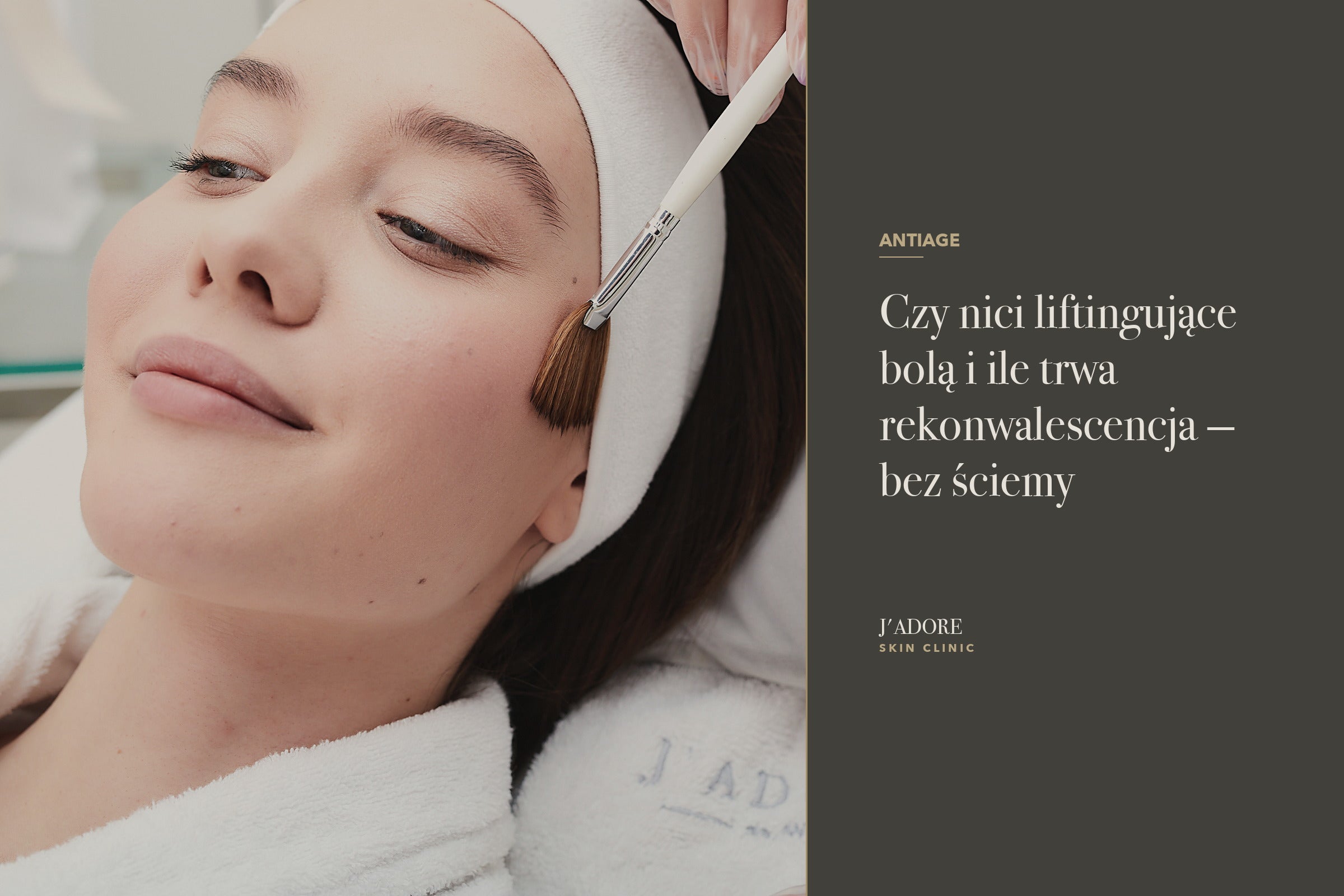
Lifting threads are one of the most frequently discussed procedures in aesthetic medicine clinics today — and one of those for which opinions can be extreme. On one end: "wonderful lifting effect without a scalpel, you can go back to work normally". On the other: "terrible pain, a week of swelling, and no effect at all". The truth is, as usual, more complex — and much more interesting than both versions. Threads are a medical procedure with real potential, but also with a real healing time, which varies depending on the type of threads, the area, and the anatomy of the individual. Before you decide, it's worth knowing the facts — not to discourage you, but to accurately assess whether this is right for you and when, and what to really expect from the clinic.
Where do so many myths about one procedure come from
Lifting threads are a topic that lives a life of its own on social media — both in the form of raves after successful procedures and dramatic accounts of side effects. Both narratives share one common feature: they are extremely shortened snippets of reality. A good result from threads won’t make it to TikTok because there’s nothing to show — "you look natural" doesn’t impress in a thirty-second video. However, swelling from a poorly planned procedure or asymmetry a few days after the procedure has already made many viral careers. Both images are true — neither is complete. That’s why we take on six statements that are most often repeated and check how much medicine is in each of them and how much is legend.
💡 Threads from surgery, not aesthetics. Absorbable lifting threads come from surgery — absorbable sutures used in operations are the technological ancestors of today’s aesthetic threads. The very idea of "supporting tissues from the inside" has been around in medicine for several decades. Aesthetics adopted and refined this tool much later.
Six myths — one by one
Myth 1: "Lifting threads are very painful". This is the most common fear and one of the biggest misunderstandings. The procedure is performed under local anesthesia — the standard is a numbing cream before the procedure and possibly deep anesthesia during. During the procedure itself, most people feel pressure and pulling, not pain in the classical sense. After the procedure, discomfort may persist for a few days: sensitivity when touching the face, a feeling of tightness in the skin, pain when opening the mouth wide. This is a normal part of healing — not a signal that something went wrong. Actual sharp pain from threads does occur and should be a signal to contact a doctor, but it is not the norm.
Myth 2: "You can return to normal life the same day after the threads". This myth is a marketing shortcut — popular because it sounds encouraging, but dangerous because it builds unrealistic expectations. Immediately after the procedure, the face is swollen, bruising may occur, and the skin is clearly irritated. Most people need at least a few days before the healing effects become discreet enough to return to normal social activities. The so-called "social downtime" — the time when you prefer not to go out for important meetings or parties — usually lasts from five to ten days. This is not dramatic. But it’s also not "I’m going straight from the clinic to dinner".
Myth 3: "The effect is visible immediately and is final right away". Threads work in two ways: mechanically (lifting tissues immediately after the procedure) and biologically (stimulating collagen production over the following weeks). The mechanical effect is visible right away — but immediately after the procedure, the face is swollen, distorting the image. The final effect, when the swelling subsides and the newly produced collagen begins to work, is usually visible after four to six weeks. What you see in the mirror in the clinic after the procedure is not what you will see in a month. And conversely — the first days after the procedure are not indicative of the effect.
💡 Threads as a scaffold for collagen. Modern absorbable threads act like a temporary scaffold: they lift tissues while simultaneously stimulating an inflammatory reaction around them — precisely and controllably. This reaction triggers collagen production. When the threads are absorbed after a few months, their role is taken over by the newly produced collagen. It’s a neat mechanism: the tool disappears, the effect remains.
Myth 4: "You can feel the threads under the skin, they will be palpable". In a well-performed procedure, threads should not be palpable under normal conditions. Immediately after the procedure and during the first days of healing, you may feel a certain "otherness" — the skin is sensitive, and you may feel tension. After a few weeks, as healing progresses, properly placed threads cannot be felt through the skin and are not visible to the naked eye. If threads are palpable as hard structures under the skin after a few weeks — it’s worth going back to the doctor. This may indicate too shallow placement or pulling of the threads in the wrong place.
Myth 5: "Threads are suitable for anyone who wants a lift". Lifting threads give the best results with a certain degree of tissue sagging — not too little and not too much. With minimal skin drooping, the mechanical lifting effect may be barely noticeable. With significant drooping and a large amount of excess skin, threads may prove insufficient, and the doctor may suggest another approach or a combination of methods. A good result also depends on the quality of the skin, the structure of deeper tissues, and anatomy. Qualification for the procedure is key here — not every face in the first category "I want a lift" is a suitable candidate for threads, and not every person rejected by one doctor is unsuitable for the procedure at all — they may just need a different tool.
Myth 6: "Lifting threads are a one-time procedure — forever". Absorbable threads — now dominant — have a specific duration of action. The body gradually absorbs them, and the lifting effect lasts for a while after the procedure — largely thanks to the aforementioned stimulation of collagen. However, this does not mean that the effect is permanent. The skin continues to age, gravity acts constantly, and the collagen produced around the threads degrades over time. Most people who are satisfied with the effect decide to repeat the procedure after some time. Threads are an investment in skin quality — not a one-time correction that "solves the issue".
The most common question during the consultation is: "will it look natural?". The answer always starts with an analysis of the face — not the procedure. Well-planned threads adapt to the natural structure, not "pulling" the skin in a direction that disturbs the expression of the face. Asymmetry immediately after the procedure (one side more swollen than the other) is normal in healing — not a mistake. The final effect is not assessed before four to six weeks have passed.
What really happens in the first weeks after the procedure
Recovery after threads is not a theatrical return to health — but also not a walk in the park. It’s worth knowing what to expect at different moments, so you don’t assess the effect at the wrong time and panic where there’s no reason. The first three days are usually the peak of swelling and bruising — it’s worse than after a week. Between the third and seventh day, the swelling subsides, bruises fade, and the face begins to look more normal. Between the first and fourth week, you can return to the vast majority of activities — excluding intense physical exertion, saunas, and hot baths, which can exacerbate swelling. The final collagen effect shapes over the following weeks. Patience here is not a decorative virtue — it is a necessary condition for a good assessment of the procedure.
💡 Cold as an ally. In the first 48 hours, cold compresses (through a cloth, never ice directly on the skin) effectively reduce swelling and discomfort. This is a simple intervention with real effects — not a myth, not a placebo. Ice on the skin after the procedure is discouraged — too great a risk of frostbite to sensitive, healing tissue.
Who are lifting threads for, and who needs something else
Lifting threads work well in the area of the cheeks, jawline, neck, as well as with drooping brows and corners of the mouth. They do not replace fillers where volume is needed — if the face has lost volume due to loss of fat tissue and bone, simply lifting the tissues will not solve the problem. They also do not replace treatments that improve skin quality — with thin, inelastic skin, the mechanical lifting effect may be weaker and short-lived. The best results come from combined treatments — threads as part of structural lifting, hyaluronic acid or biostimulators as a complement to skin quality. This approach is increasingly treated by aesthetic medicine doctors as standard, not as an extravagance.
A good lifting thread procedure starts with a detailed analysis of the face, discussing expectations, and planning. A doctor who proposes threads without a preliminary examination, without questions about the history of procedures, and without a conversation about realistic effects — should raise your alertness. Threads poorly matched to anatomy or inserted too shallowly give results that are difficult to correct. In the case of a medical procedure, consultation is not a formality — it’s half the procedure.
One note applies to both sexes — and it’s worth saying it outright. Men after lifting threads report similar effects as women, but anatomical differences are significant here: thicker skin and stronger musculature often require different techniques and different planning of thread lines. At J'ADORE, the procedure is performed by a doctor who assesses anatomy individually — it is not performed based on one template that fits everyone.
💡 Men and threads — growing interest. Just a few years ago, lifting threads were almost exclusively a "female" procedure. Today, men make up an increasing percentage of patients — mainly due to the neck area and jawline. "Tired face" and drooping jaw are specific problems that are treated task-oriented, not aesthetically.
What remains when the myths fade
Lifting threads are a procedure with real potential and real limitations. They do not "eliminate" signs of aging — they affect them precisely, within a certain range, for a certain time. Recovery takes less time than after surgical operations, but longer than after filler injections. Pain is managed with anesthesia, but discomfort in the first days is part of the process. The effect is not eternal, but it can be clear and natural. The most important decision is not "do I do threads or not" — it’s "who does it and based on what analysis". This statement is the common denominator of all the myths on this list: most complications and disappointments begin not with the threads themselves, but with planning, qualification, and technique.
If after reading this text you have more questions than at the beginning — that’s a good sign. Threads are not a product you buy off the shelf. They are a medical procedure that deserves a thorough conversation with a doctor — before the decision, not after.


