

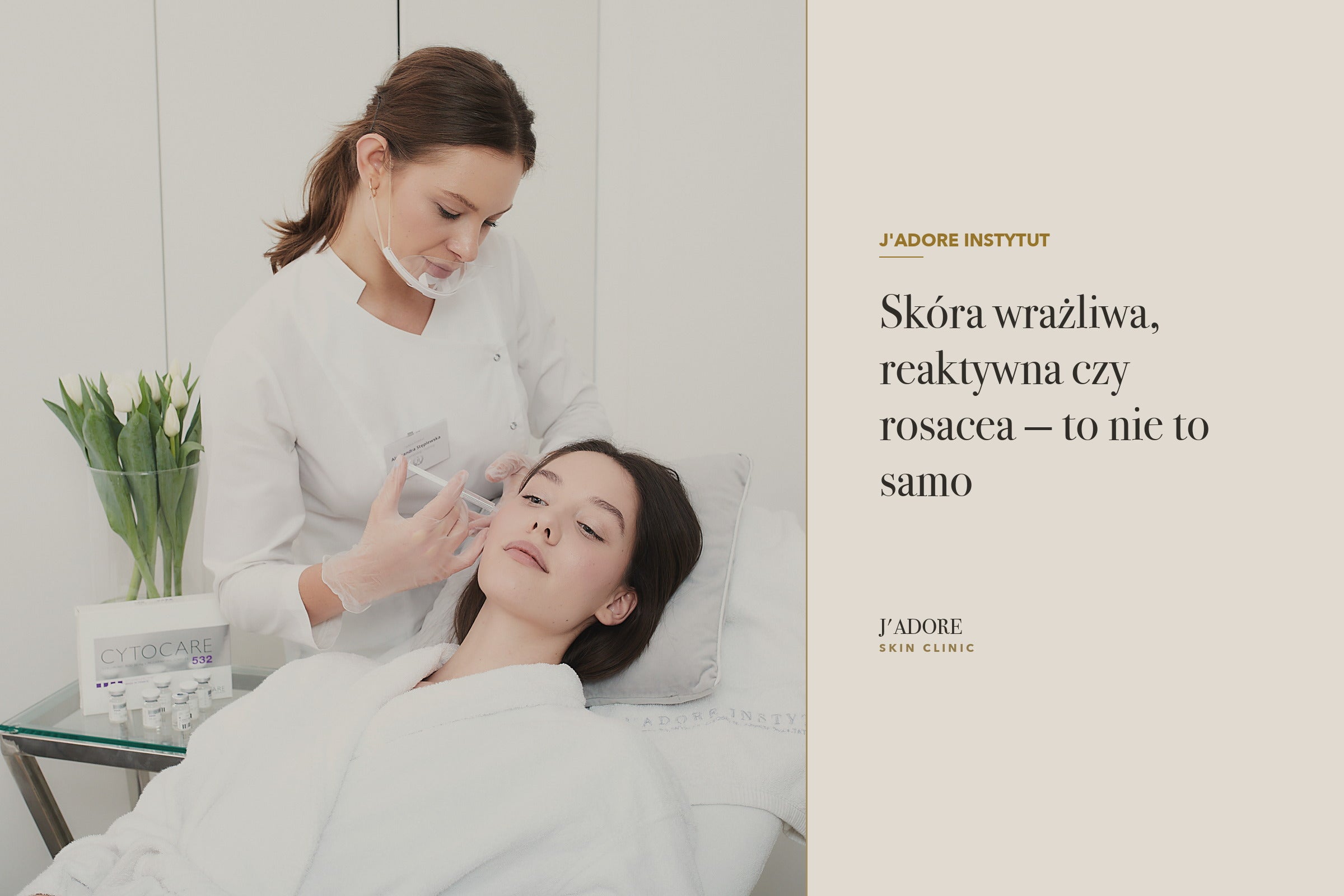
Red cheeks after going out in the cold, a burning sensation after applying cream, visible capillaries under the skin — many people lump all of this together and say: “I have sensitive skin.” Meanwhile, sensitive, reactive, and rosacea are three different conditions — each with a different cause, a different clinical picture, and a completely different care plan. Confusing them not only doesn’t help but often makes the skin react even more intensely. To choose the right approach, you first need to know what you are dealing with.
Three conditions, three different mechanisms
Before we move on to the differences, it’s worth understanding one thing: each of these conditions has a different source — that’s why the same cream can soothe sensitive skin while simultaneously exacerbating rosacea symptoms. The shortened logic can be summarized as follows: sensitive skin has a weak barrier, reactive skin is too nervous, and rosacea is chronically inflammatory.
All three conditions share one common symptom — redness — and all three most often affect the face. That’s enough to confuse them. But the mechanism is completely different: a weak barrier (sensitive), the nervous system of the skin (reactive), and the immune system + blood vessels (rosacea). Hence the fundamental difference in what helps.
How to figure out what you are dealing with on your own
None of the following tips can replace a specialist’s diagnosis, but they can help set the conversation with a cosmetologist or dermatologist on the right track. Observe your skin for a few days and ask yourself these questions:
- When does it turn red? If only after specific cosmetics or washing — a barrier signal (sensitive). If after a glass of wine, hot soup, or strong stress — reactive. If almost all the time, without a clear reason — rosacea.
- How long does the redness last? A few minutes → reactive. A few hours → rosacea. Burning with every contact with cosmetics → sensitive.
- Do you see red threads under the skin? Visible telangiectasias are one of the characteristic images of rosacea — with ordinary sensitivity, they are not present.
- Do bumps and pustules appear without blackheads? Raised changes without blackheads are one of the subtypes of rosacea — it’s worth consulting this.
- Does your skin “breathe”? Sensitive skin often improves after simplifying care. Rosacea usually does not.
Rosacea is a clinical diagnosis — made by a dermatologist or an experienced cosmetologist after assessing the skin, taking a history, and excluding other causes (lupus, acne rosacea subtype 2, allergic reactions). Self-diagnosis can lead to using products that exacerbate symptoms. If rosacea is suspected — consultation is key.
Why this distinction is practically important
This is not a minor terminological difference. The same care can soothe one condition and exacerbate another. Here are a few examples from practice:
- Acid peeling — for sensitive skin, it can help rebuild the barrier (proper selection!); for rosacea, it is contraindicated during flare-ups.
- Heating massage — relaxes and improves circulation; for reactive and rosacea, it can trigger a flushing attack.
- Rich emollient cream — saves the barrier in sensitive skin; for acne rosacea subtype, it can exacerbate bumps.
- Retinoids — in low concentrations, they can support skin renewal in sensitive skin; for rosacea, they require great caution and gradual introduction.
Regardless of whether you have sensitive, reactive, or rosacea skin — fewer products, gentler formulas, fewer active ingredients at once. This is a common denominator to start with. The difference lies in what we do next.
That’s why in a cosmetology office, the first step is not “what treatment,” but a thorough interview and skin assessment. The cosmetologist looks at the patterns: when does it turn red, is there symmetry, do bumps appear, how does it react to the environment. Only then can it be decided whether we are going towards rebuilding the barrier, calming reactivity, or controlling inflammation.
What can help each of these conditions
Each condition has different therapeutic priorities. This is not a closed list — the plan always depends on the individual skin — but the outline of the approach is as follows:
You leave the cosmetology consultation with something you didn’t have before — with a specific name for what is happening with your skin. Not “sensitive,” because that’s what all pharmacy creams say. Only precisely: weakened barrier, vascular reactivity, early rosacea. And only then is the plan tailored — treatments, home care, possible referral to a dermatologist. This makes all the difference between wandering and effective action.
When it’s worth combining approaches
These conditions can coexist — and often do. A person with rosacea often also has a weakened barrier (sensitive skin to cosmetics), and vascular reactivity is one of the mechanisms underlying rosacea. Therefore, a good care plan often addresses more than one level at the same time.
Before any vascular or laser treatment with suspected rosacea, a consultation is necessary — some procedures are contraindicated during flare-ups or with active bumps and pustules. The timing and selection of the treatment depend on the current state of the skin.


