

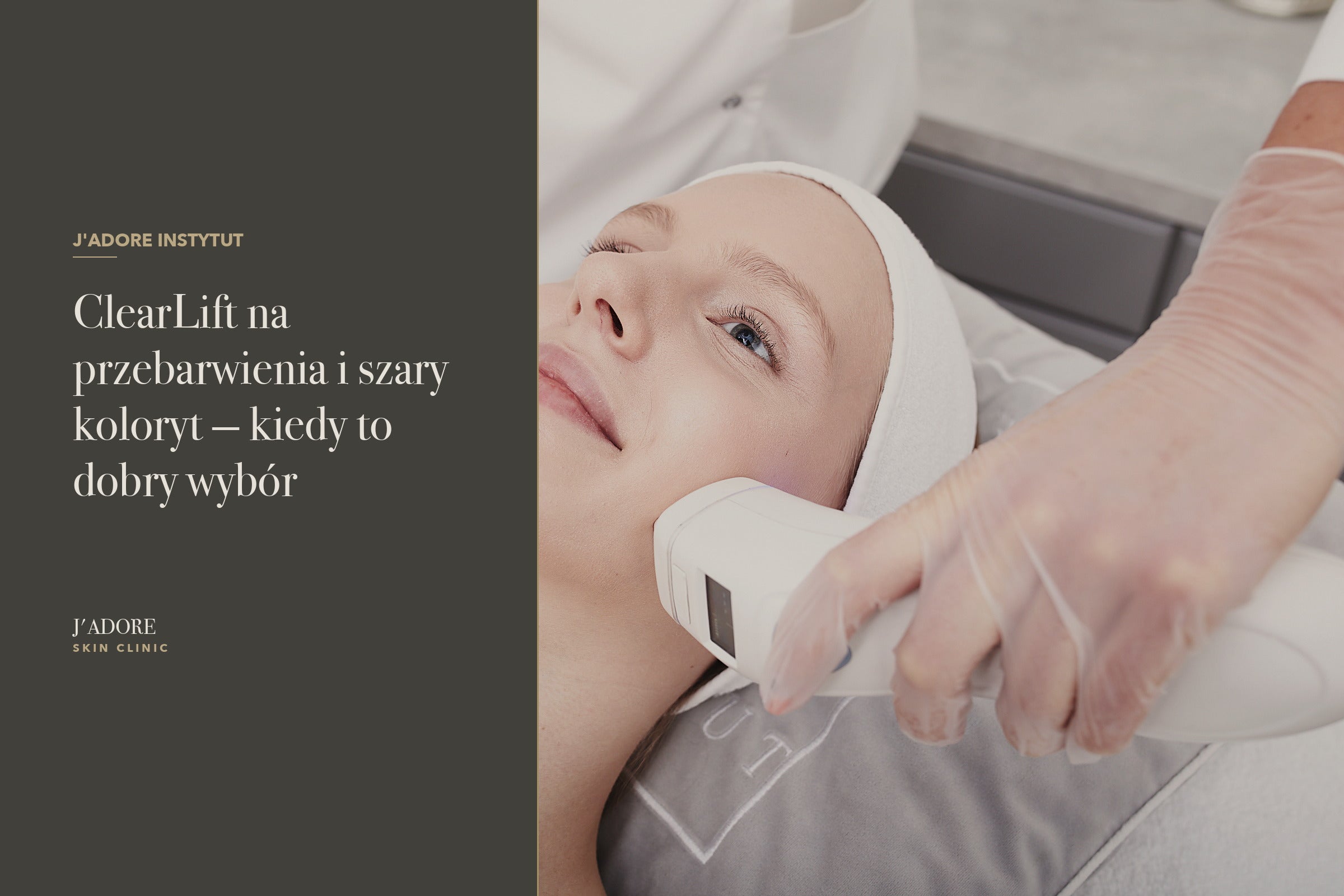
Sun spots, uneven skin tone after acne, skin that loses its glow year after year and becomes gray, as if tired — these are complaints that many people bring to the beauty salon. And rightly so, because these changes have their cause deep within the skin, not just on its surface. ClearLift is a laser that is often described as "no downtime lifting" or "gentle fractional laser". Both descriptions convey something true, but neither explains why this particular laser effectively addresses pigmentation and loss of glow. And that is a question worth answering — because when you understand the mechanism, it is easier to assess whether a given tool fits your problem. In this text, we break down ClearLift into its components: what happens to the skin during the treatment, why you can leave the salon without a visible mark on your face, and for whom this method makes the most sense — and for whom it is worth considering something else.
Where pigmentation and dull complexion come from
To understand why ClearLift works where it does, you first need to know what lies behind pigmentation and loss of glow. This is not a single problem — it is several different processes that may look similar in the mirror.
- Melanin and its distribution. Skin color is created by melanin — a pigment produced by cells called melanocytes. In healthy skin, melanin is distributed evenly. When the skin is exposed to the sun for years, melanocytes in some areas "switch" to higher production — and thus spots, sun-induced pigmentation, and so-called age spots are formed. Melanin accumulates locally, instead of being evenly distributed.
- Post-inflammatory hyperpigmentation (PIH). Any inflammatory condition — eczema, pimple, micro-injury — can stimulate melanocytes to work harder. The result is a brown or gray-brown spot after healing. It can be more persistent than the pimple itself, as melanin lingering in the dermis can remain for months.
- Dullness and loss of glow — a different mechanism. This is not so much pigmentation, but rather the effect of accumulation of dead skin cells, slowed cellular renewal with age, and weakened microcirculation in the skin. The skin does not "glow from within" because cell turnover is slower, the stratum corneum is thicker, and blood flow is weaker than it used to be.
Pigmentation can be misleading: in the mirror, it looks like a "spot on the skin", while melanin can reside both in the epidermis (superficially — and this is easier to address) and deeper, in the dermis. The laser finds it easier to work with epidermal melanin — which is why it is worth knowing how deep the problem goes before the treatment. This is one of the things that the specialist assesses during the consultation.
These three mechanisms can overlap — and often do. Dull skin and pigmentation and post-acne marks are not exceptions, but a typical picture of many adult skins. Therefore, a good treatment plan takes into account which element predominates the most, rather than just "we do laser because there are spots".
How ClearLift reaches pigmentation
ClearLift is a laser from the Harmony series by Alma Lasers, working in fractional mode and in the near-infrared spectrum — a wavelength that pigment and tissue absorb in a controlled manner. But the technical details are less important than the principle worth remembering: laser energy penetrates deep into the skin without burning its surface.
In a classic ablative laser (i.e., one that "removes" a layer of skin), the effect is quick, but at a cost: the skin after the treatment is red, sensitive, and requires several days or weeks of recovery. ClearLift works differently — the head with an optical mirror transfers the energy focus below the epidermis, deep into the dermis, leaving the surface practically untouched. Hence the term "no downtime".
Laser energy causes micro-thermal damage in the dermis — controlled, pinpoint, with a very small diameter. The body reacts to it as it does to any injury: it activates repair. Fibroblasts (collagen-producing cells) begin to work. Old, damaged fibers are removed, and new ones are built. Meanwhile, melanocytes in the stimulated area can be selectively deactivated or melanin broken down into smaller fragments that can be more easily captured and removed by the lymphatic system.
"Fractional" means that the laser does not work on 100% of the surface — it creates a pattern of micro-points with intact areas of skin between them. These untouched zones become a reservoir of cells that repair the affected areas. The effect: healing is faster, the risk of complications is lower, and the skin can work more intensively without being overly burdened. This is the same idea behind popular fractional lasers in dermatology.
In short: the laser does not so much "remove" pigmentation from the surface — it breaks down accumulated melanin and stimulates the skin to do its own work, thanks to which pigmentation gradually disappears. That is why the effects of ClearLift appear over several weeks after the treatment, not immediately the next day. The skin does the work itself — the laser just gave it a boost.
No downtime treatment — what does it really mean
"No downtime" (in English no downtime) is one of those terms in cosmetology that conveys something true but requires clarification. ClearLift really differs from ablative lasers in that after the treatment, the skin does not require social isolation: you can return to work, apply makeup, go out for a meeting. This is a real advantage.
No downtime does not mean that after ClearLift the skin is exactly as it was before. For several hours or a day, it may be slightly sensitive, slightly red — but to a degree that does not interfere with daily functioning. It is advisable to avoid saunas, intense physical exertion, and direct sun exposure for a few days.
There is another aspect of "no downtime" that is less often mentioned: no downtime also applies to the skin. Since the epidermis is not removed, the skin's protective barrier functions almost normally throughout the healing process. For people with sensitive, reactive skin or barrier issues, this is a significant difference compared to more invasive methods.
For whom ClearLift makes the most sense
ClearLift is not the answer to every pigmentation issue — it is a very good answer to a specific type of problem and a specific skin type. It is worth knowing where this method excels and where it is better to reach for another tool.
- Sun-induced pigmentation (lentigines). Flat, brown spots on the face, décolletage, and hands — the result of sun accumulation over the years. This is a classic indication for lasers working on melanin. ClearLift often handles them well, especially when they are superficial.
- Uneven skin tone and dull complexion. Skin that looks tired, matte, lacking glow — without distinct spots, but without expression. Laser pulses stimulate cell renewal and microcirculation. For many people, the effect is a more pronounced glow and even skin tone after a series of treatments.
- Post-inflammatory pigmentation after acne. Superficial, brown marks after breakouts. ClearLift can help lighten them — especially when active acne is already under control.
- Early signs of photoaging. Before changes become deeper — laser as prevention and improvement of skin quality. Strengthening collagen, improving texture, evening out skin tone.
- Darker skin (phototypes III–V). This is a significant advantage. Many lasers working on pigment carry the risk of hyper- or hypopigmentation in darker phototypes. ClearLift — with the right parameter selection and the specialist's experience — is often a safer option for people with darker complexions.
The decision of whether ClearLift is the right choice for a specific person always requires consultation. It is crucial to distinguish: whether melanin is superficial (epidermis) or deeper (dermis) — because this affects what the laser can realistically achieve. With deep melanin (e.g., hormonal melasma), laser therapy alone may not be sufficient and requires a multi-faceted approach.
When ClearLift may not be the best choice
Honesty requires stating outright: there are situations where ClearLift is not the optimal tool — and it is better to know this beforehand than to be disappointed afterward.
- Melasma. This is one of the most challenging pigmentation issues — hormonal, chronic, often deep. The laser can temporarily lighten it, but too aggressive stimulation can also exacerbate it (the rebound effect). In melasma, combined protocols usually work better: a gentle laser with depigmenting care and strict photoprotection. ClearLift alone without a strategy may be insufficient.
- Deep acne scars. With pronounced indentations in the skin (atrophic scars, icepick scars), methods that reach deeper are needed — stronger fractional laser, microneedling, radiofrequency. ClearLift can be a complement, but it will not resolve the deep structure of the scar on its own.
- Active inflammatory conditions. Active acne, herpes in the active phase, skin inflammatory conditions — contraindications for lasers in general. First, calm the inflammation, then use the laser.
- Expecting instant results after one session. ClearLift is a cumulative method. If someone needs a noticeable change quickly — an ablative laser, strong chemical peel, or another protocol may be more appropriate.
Different lasers have different wavelengths, different mechanisms, and different indications. The question "does laser help with pigmentation" is like asking "do medications help with headaches" — it depends on which one and in what dosage. A good specialist does not ask "whether laser", but "which laser, in what combination, for what specific problem" — and often a combined protocol yields better results than a single treatment used alone.
Series or single treatment — how it really works
One of the more common misunderstandings surrounding ClearLift (and non-ablative lasers in general) is the belief that the effect should be immediately visible. Meanwhile, the mechanism of action — stimulating the skin's own repair processes — requires time and repetitions.
The pace and scale of effects are individual — influenced by skin type, depth of pigmentation, skin age, consistency in home care, and sun protection. Results described by others may differ from yours — and that is normal, it does not indicate poor treatment efficacy.
What to combine with ClearLift
ClearLift works well on its own, but combining treatments can yield effects that none of them can achieve alone. The logic is simple: the laser addresses depth — melanin and collagen stimulation, but certain aspects of skin condition are worth supporting in parallel with other methods or consistent home care.
One of the things that surprises people after their first ClearLift session is the lack of a dramatic "trace". No stripping, no bloody face — just slightly pink skin, a warm feeling for an hour. And this raises the question: "did anything happen?". The answer is: yes, only inside. The laser works discreetly — and that is its advantage, not a drawback. The effect will come, but not immediately — the skin needs time to do what you stimulated it to do.


