

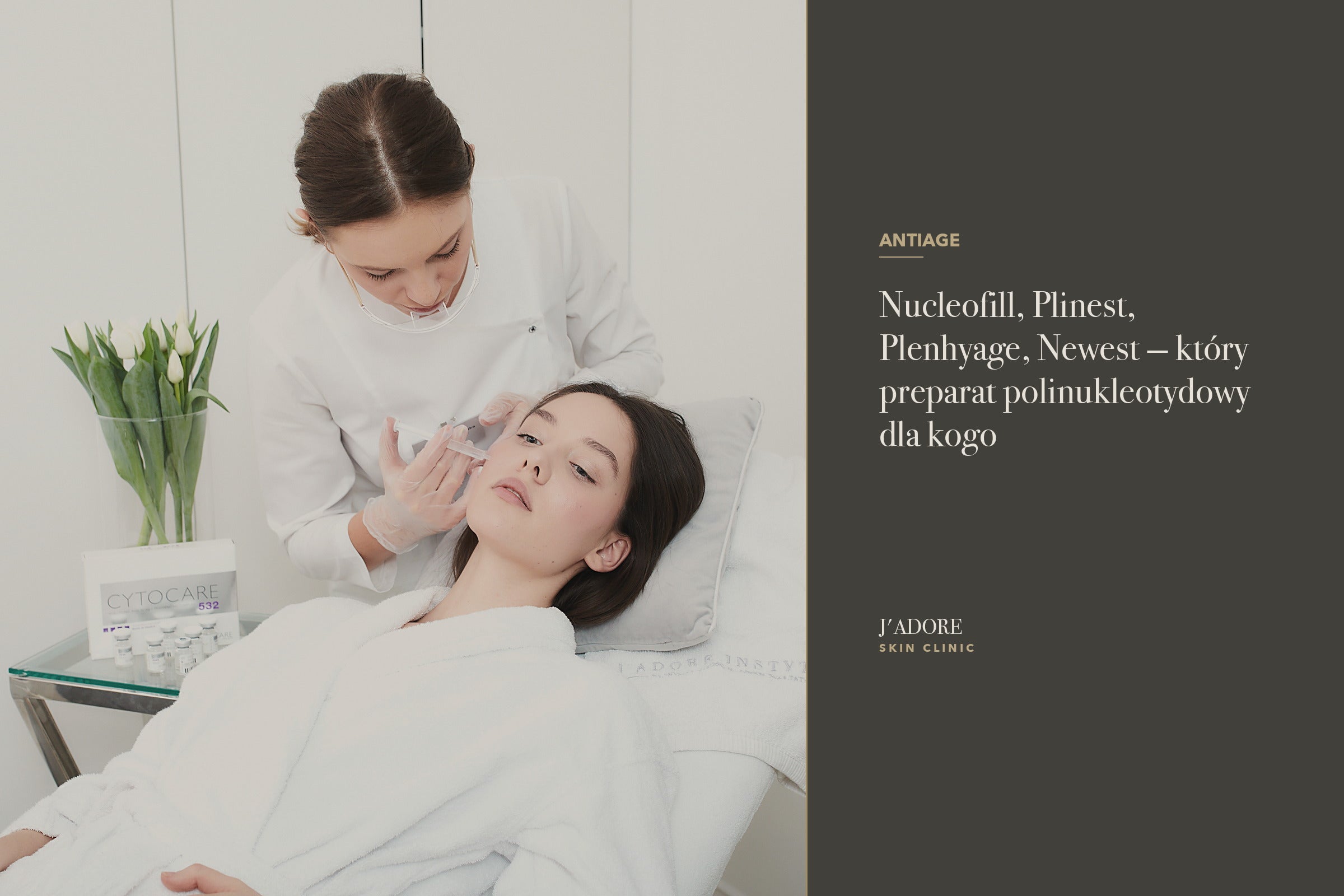
There is an increasingly popular view that polynucleotides are polynucleotides — that since they all belong to the same class, the choice between Nucleofill, Plinest, Plenhyage, and Newest is a matter of price or availability, not medicine. This is a convenient but false view. In reality, these preparations differ on several levels at once: concentration, molecular weight, carrier, consistency, and thus — the logic of application. One will work for dehydrated and tired skin, another for deeper loss of density, yet another when the priority is the delicate eye area. Choosing "some" without this distinction is like selecting an orthodontic appliance without measurement — it can be worn, but it doesn't work as it should. In this text, we are not ranking "which is best". We are doing something more useful: explaining the mechanism, clarifying the differences, and stating which preparation makes sense for which skin profile. Because a wise conversation with a doctor begins with understanding — not from a name read on the internet.
What are polynucleotides — and why does the skin react to them
Before we compare the preparations, we need to understand the mechanism. Polynucleotides (PDRN/PN) are long chains of DNA fragments, most often derived from salmon or trout roe. It may sound exotic, but solid biology stands behind it: these fragments have the ability to bind to adenosine receptors (A2A) on the surface of skin cells, which stimulates fibroblasts to produce collagen and elastin and supports repair processes.
This is an important distinction compared to hyaluronic acid or biostimulators: polynucleotides do not "fill" or "lift". Their role is more fundamental — they regenerate the environment in which skin cells live, improving its condition, hydration, and ability to renew itself. The effect is therefore more subtle and gradual than with filling, but also more lasting in a qualitative sense: the skin becomes better skin, not just looks better.
💡 Interesting fact: the DNA of salmon and humans is surprisingly similar. This is why fragments of polynucleotides from salmon can interact with human cell receptors without triggering an immune response. This is not marketing — it is phylogenetic closeness that makes the body treat these molecules as "its own". Hence the very low percentage of allergic reactions with well-purified preparations.
- PDRN (polydeoxyribonucleotide) — shorter chains, absorbed faster, more intensely stimulate A2A receptors. A stronger regenerative effect "immediately", more focused on repair.
- PN (polynucleotide) — longer chains, absorbed more slowly, act longer as a moisturizing "scaffold". More moisturizing, slower, more gradual effect.
- Most premium preparations contain a mixture of both fractions or clearly dominate one of them — and it is this difference that determines "which for whom".
Nucleofill, Plinest, Plenhyage, Newest — how do they really differ
The four brands that dominate Polish clinics differ not only in name. Each has its own formulation philosophy — different ratios of fractions, different concentrations, different consistencies, different logic of product lines. Below is a short map that will help understand the direction each of them is heading.
💡 Interesting fact: "concentration" is not everything. One might think that the higher the concentration of polynucleotides, the better the preparation. However, this is a simplification — purity is also key (the cleaner, the fewer reactions), molecular weight (short chains act differently than long ones), and carrier, which determines how deeply and evenly the preparation is distributed. Therefore, directly comparing preparations based solely on the concentration on the packaging is somewhat like judging wine by its alcohol content.
Which preparation for which skin — indication map
Now specifically — for which skin profile does which preparation make logical sense. This is not a rigid rule, as every skin is different, and the final decision is made by the doctor after assessment. But this map will help understand why a clinic should not have "one polynucleotide for everything".
- Dehydrated, gray, dull skin, but without deeper changes → Plinest or Plenhyage. The priority is cellular hydration and rebuilding the skin environment. The effects are noticed here faster in quality and glow, rather than tension.
- Loose skin, with loss of density, tired from the sun or after pregnancy → Nucleofill or Newest Strong. A stronger regenerative profile makes sense when the skin needs an impulse to rebuild collagen, not just hydration.
- Combination skin: dry and loose at the same time → Plenhyage XL or combined protocol. The combination of PN fraction with hyaluronic acid addresses both problems without compromise.
- Delicate eye area → Nucleofill Eyes or Newest Light. The eye area requires a preparation with a specially selected consistency and concentration — not every preparation from the "face" line is indicated here.
- Sensitive, vascular skin, with a history of reactions → Plinest or Newest (with confirmed purity). High purity of the preparation reduces the risk of reaction, which is significant here.
- Scars, stretch marks, skin booster after laser procedures → Newest or PDRN-dominant protocols. A stronger regenerative and anti-inflammatory effect is the right logic.
💡 Interesting fact: polynucleotides started in regenerative medicine, not aesthetic. Their first clinical applications were in the treatment of wounds, ulcers, and inflammatory joint conditions. They entered aesthetic medicine when it turned out that the same ability to stimulate tissue repair works just as well on aging skin. This is an interesting example of a "dual life" of a substance — because the aesthetic effect is actually a side (and desired) effect of regenerative action.
Protocols, series, and combinations — how it looks in practice
Polynucleotides are not a one-time treatment. The logic of action requires a series — usually several sessions at regular intervals, after which a maintenance phase follows. The mechanism is gradual: the preparation "activates" repair processes in the skin, but these processes need time to yield results. Someone who expects a spectacular difference after one session may be disappointed — someone who watches the changing quality of their skin over several weeks understands why this method has a growing group of supporters.
An important question is also combining with other methods. Polynucleotides work well with biostimulators (which work on a similar principle but with a different mechanism — cf. Sculptra, Radiesse), with mesotherapy as a moisturizing complement, and with lasers — they are often used as regenerative support after the procedure. However, they are not typically combined with fillers in the same session in the same areas, as that follows a separate logic of action.
The question "which polynucleotide do you recommend?" we hear often and understand where it comes from — the internet is full of comparisons. But the honest answer is: it depends on your skin, not on the trend. We see skins where Plinest brings incomparably better results than Nucleofill — and vice versa. The difference lies in what the skin needs most: deep hydration, an impulse to rebuild collagen, or a combination of both. Therefore, before we recommend a specific preparation, we look at the skin — not at the packaging.
What to do with this — a practical step forward
The article has given you a map. Now it’s a matter of decision. If you have heard about polynucleotides and are wondering if it makes sense for your skin — the answer is: perhaps yes, but only with a well-chosen preparation and protocol. "I did polynucleotides, they didn't work" is a sentence we hear — and almost always behind it lies either a poorly chosen preparation, or too short a series, or an expectation of an effect that polynucleotides are not intended to deliver (e.g., lifting or reducing deep wrinkles).
A sensible path looks like this: first a consultation, during which the doctor assesses the skin and determines which preparation makes logical sense for your profile — and whether polynucleotides are even the best choice at this stage, or perhaps another treatment addresses your problem better. Polynucleotides are indeed a good method — but "really good" means "with the right indication", not "for everyone and always".
The skin loses its glow and hydration, which cosmetics no longer restore. The first signs of looseness appear without clear wrinkles. The skin regenerates more slowly after sun exposure, stress, or procedures. You are looking for an improvement in skin quality, not a change in volume or contours.
Nucleofill, Plinest, Plenhyage, and Newest are medical preparations used exclusively by doctors or under their supervision. The choice of preparation, number of sessions, and protocol depends on the individual assessment of the skin — the information in this article is educational and does not replace consultation.


