

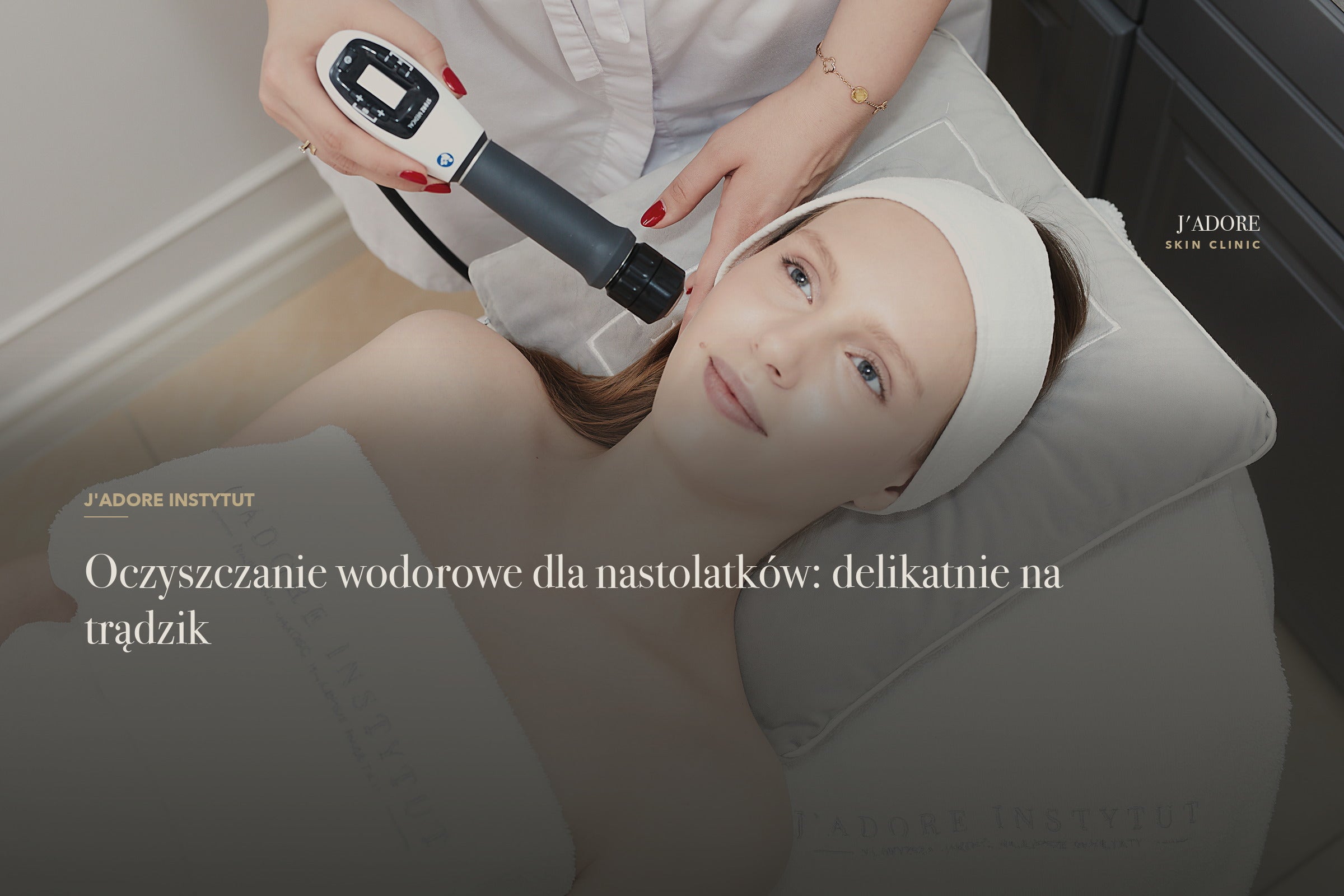
There is something particularly unfair about teenage acne: it appears just when looks matter the most — and when every pimple feels like a disaster for the whole class. Maybe you stand in front of the mirror feeling that whatever you try, the results are poor. Or you are a parent who sees their child hiding their face behind their hair and doesn’t know how to really help them. I have important information for you: acne at this age is very rarely a matter of poor hygiene. It’s biology — specific, hormonal, predictable. And that’s why aggressive scrubbing, layering on more “drying” products, or squeezing under the bathroom light does not solve the problem and often makes it worse. This text is a practical guide: what really happens to a teenager's skin, why hydrogen cleansing can be such a good fit for it, what such a treatment looks like step by step — and when home remedies should give way to a visit to a specialist. Without scare tactics, without empty promises.
Is it really a problem — or just a "phase"
We will start with a question that many people are afraid to ask out loud: is this already a problem that requires action — or does it just need to pass? The answer is somewhere in the middle, but closer to action than often thought.
Yes, teenage acne is very common — it is one of the most frequent dermatological processes in human history. And yes, for some people, it really goes away with age without intervention. But waiting is not neutral: during this time, scars, post-inflammatory hyperpigmentation form on the skin, and — more importantly — skincare habits that can be more harmful than acne itself become entrenched.
If any of the above situations sound familiar — waiting stops being a strategy and becomes a risk. Professional cleansing is not an exaggeration; it is a logical step that protects the skin from consequences that are not immediately visible.
💡 Fun fact: squeezing a pimple in the mirror and a cleansing treatment in the office are two completely different procedures — although they look similar from the outside. In the office, the skin is properly prepared beforehand, and the removal of the blackhead occurs without creating micro-inflammatory damage that leaves a mark. That’s why professional cleansing leads to scars less often than home combinations.
Why a teenager's skin behaves the way it does
Before you understand why hydrogen cleansing can help, it’s worth understanding what you are really fighting against. Teenage acne is the result of several overlapping mechanisms — and each requires a different approach.
Practical conclusion: a treatment that really helps a teenager must work on a mechanical level — removing what clogs the pores — and at the same time not exacerbate inflammation or damage the skin barrier. This is exactly where hydrogen cleansing fits in.
💡 Fun fact: a teenager's skin produces sebum at a different rhythm than an adult's skin — sebaceous glands at this age can work several times more intensely. That’s why tips from adult skincare guides often don’t work for teenagers: it’s simply different skin, with different skincare priorities.
Hydrogen cleansing — what it looks like in practice
Hydrogen cleansing (also known as oxygen infusion) is a treatment that combines mechanical pore cleansing with simultaneous hydration and oxygen saturation of the skin. For many teenagers, it is their first “real” encounter with a beauty salon — and fortunately, it is usually surprisingly comfortable.
How does it work? The device generates a stream of water and oxygen under low pressure, which gently empties the pores of accumulated sebum and dead cells without damaging the delicate skin barrier. During the treatment, active ingredients can be delivered to the skin — for acne, most often with anti-inflammatory and sebum-regulating effects.
Teenagers often come in with the belief that the treatment “hurts like squeezing” — and are positively surprised. Hydrogen cleansing usually doesn’t hurt at all; sometimes there is a slight feeling of suction at the pores with a lot of blackheads, but that’s it. This is one of the reasons why this treatment works so well for young people: no pain = no fear = regular visits. And regularity is key with acne-prone skin.
The treatment is safe for sensitive and actively acne-prone skin — provided it is performed by a beautician who works with teenage skin and adjusts the depth and selection of ingredients to the current state of the skin. Not every cleansing is the same.
What NOT to do — mistakes that worsen the problem
The list of mistakes with teenage acne is surprisingly long — and many of them are the result of good intentions, not neglect. Here are those that beauticians see most often.
💡 Fun fact: one of the biggest paradoxes of acne care is that aggressive drying of the skin — a popular strategy for “fighting oil” — often leads to a yo-yo effect. The skin loses water, the sebaceous glands get the signal “too little” and increase sebum production. The effect? The face shines even more. That’s why moisturizing is important even with oily skin — it’s simply a matter of choosing the right product.
When to see a specialist — and which one
Hydrogen cleansing is a great foundation for regular skincare — but there are situations where cosmetology alone is not enough, and it’s worth expanding the team to include a doctor. This is not a cause for concern, it’s just information.
- Acne is deep, cystic — painful, raised lesions that do not have a typical white head and do not respond to cleansing. This indicates a dermatologist.
- Lesions appear not only on the face but also on the back, shoulders, chest — a widespread picture requires medical evaluation.
- After each lesion, clear scars remain (indentations, irregularities) — here it is important to stop the scarring process as soon as possible.
- The child has very severe acne despite regular skincare and treatments — dermatological or hormonal therapy may be indicated.
- Acne is accompanied by other symptoms: significant cycle irregularity in girls, severe hair loss, excessive hair growth — this is a signal for an endocrinologist, not a beautician.
With moderate comedonal and papulopustular acne — which is the most common in the teenage group — a beautician with experience in acne-prone skin is the right first step. Hydrogen cleansing in a series, support with home care, and patience is a plan that gives real improvement for most people.
If you have doubts about where to start — at J'adore, we start with a consultation: a conversation about the skin, its history, and current condition. We leave with a plan, not guesses. Sometimes the treatment is done right away on the first visit; sometimes there is a series of questions first and only then a plan — it always depends on the specific skin.
For treatments for teenagers (up to 18 years old), parental or guardian consent is required — this is standard procedure in every beauty salon. Visits with a parent are welcome here.


