

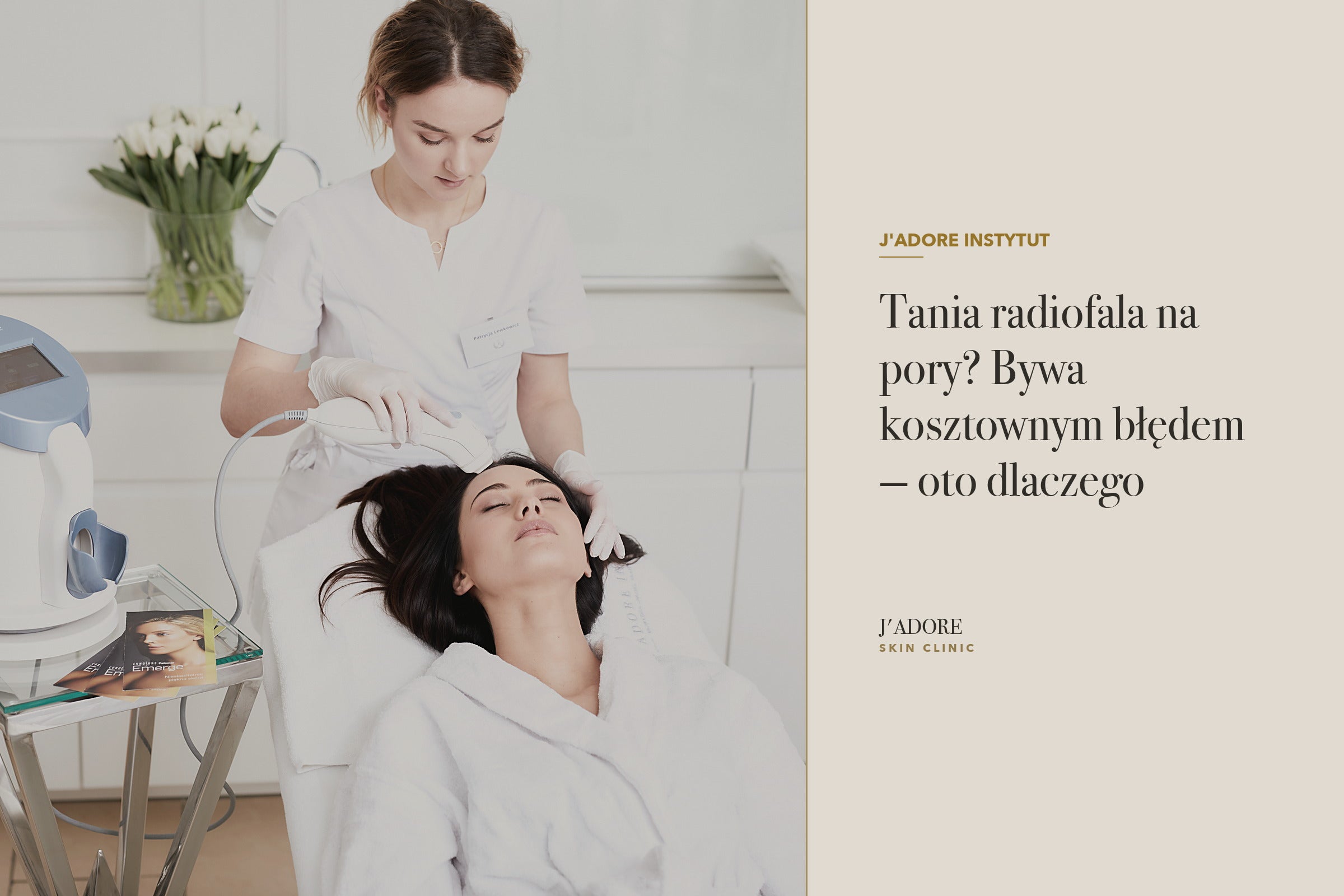
Radiofrequency has gained a reputation as a treatment for almost everyone — it smooths, lifts, tightens pores, and improves the facial contour. It sounds like a comprehensive solution for every skin problem, and that's what makes offers appear everywhere, often at very attractive prices. What the price lists do not explain is that radiofrequency works at a level deeper than any home care — and that the same depth that makes it effective can also mean that an improperly performed treatment can have the opposite effect. We gather six myths that we hear most often and lay them alongside the facts — including why the price of the treatment should never be the first criterion for choice.
How radiofrequency works — and why it matters for every myth
To understand why certain beliefs about radiofrequency are misleading, it's worth knowing what the mechanism itself entails. Radiofrequency energy converts to heat in the tissues — not on the surface, but deeper, in the dermis and subcutaneous tissue. This heat stimulates fibroblasts (collagen-producing cells) to work harder and causes immediate contraction of existing collagen fibers. The effect for many people is gradual elasticity, improved density, and skin tension — but also, if the energy is applied too aggressively or in the wrong place, tissue damage, irregular indentations, and paradoxical thickening of pores. Between these two scenarios often decides one thing: the quality of the device and the knowledge of the operator.
Pores do not have their own muscles or valves — their appearance depends on the tension of the surrounding skin and the amount of sebum produced. Radiofrequency, by increasing the elasticity of the dermis, can optically reduce the diameter of pores for many people. But this is an indirect effect, dependent on the quality of collagen, not a direct "closing" of the pore like squeezing a vessel.
Six myths worth knowing
Myth 1: “Radiofrequency is for everyone and for every purpose". This is one of the most common reasons for disappointment with the treatment. Radiofrequency works best on skin with preserved elasticity and proper hydration levels — skin that is very dry, lacking moisture, or with a severely damaged barrier may react more strongly to heat than it should. Similarly, in a person with active inflammatory acne, heating the tissues often exacerbates the inflammatory state instead of alleviating it. Not every skin problem can be solved with radiofrequency, and improper qualification is the shortest path from promise to problem.
Myth 2: “The result is immediately visible and lasting". Part of the effect — the contraction of existing collagen fibers — can indeed be visible quickly. But the proper effect of collagen remodeling matures over weeks, and often the full result is only visible after several months. This is not a flaw of the treatment — it is physiology. The problem arises when a client expects an immediate and lasting response and, after seeing no effect after a week, goes for another, this time stronger treatment — adding heat to still immature tissues.
Myth 3: “More pain = stronger effect". This is a dangerous simplification. Pain during radiofrequency may indicate overheating of the epidermis — not deeper, more effective stimulation. A well-calibrated treatment is felt by most people, but should not be painful to the point where the skin is red or blisters appear. Heat tolerance is individual and depends on skin thickness, hydration state, and nerve sensitivity — not on the "effectiveness" of the treatment.
Myth 4: “The effects of radiofrequency cannot be reversed, so nothing bad will happen". Unfortunately, it can. An overly intense or too frequently repeated treatment can lead to loss of facial fat tissue in areas where the energy was excessive. The human face is not a desirable place for intentional tissue weight loss — and that is why the treatment protocol, meaning the distribution of energy, selection of the head, and number of passes, is a substantive issue, not just a salon preference.
In common language, “radiofrequency" and “HIFU" are often used interchangeably, although they are two different technologies. Radiofrequency (RF) heats tissues through high-frequency electric currents. HIFU focuses a beam of ultrasound at a precise point deeper. Both treatments stimulate collagen, but they work at different layers and on different physical principles. An operating room or a clinic with real HIFU is not the same as a device described as “radiofrequency with HIFU effect" in a promotional brochure.
Myth 5: “All radiofrequency devices work the same — only the price of the treatment matters". This is a myth that is actively perpetuated by market logic. Radiofrequency devices differ in the depth of energy penetration, the way they control tissue temperature, the ability to cool the epidermis, and the operating mode of the heads. A medically certified device, regularly calibrated, operated by a person knowledgeable about facial anatomy — and a cheap device without certifications, where the “program" is a knob set to depth once and for all — are two different treatments under the same name. A client comparing prices assumes they are comparing the same thing. Often they are not.
Myth 6: “Radiofrequency is suitable for every skin type, including acne-prone and vascular". Heating vascular and capillary-prone skin can clearly worsen the condition of the vessels — the spider vein network may intensify, and congestion may last longer than usual. Actively acne-prone skin with many inflammatory lesions is another contraindication for careless use of thermal energy. This does not mean that radiofrequency is never suitable for such skin — it means that the protocol and parameters must be tailored individually, not from a default menu.
Radiofrequency is a medical procedure in the sense of affecting living tissues — and should be performed by someone who understands facial anatomy, can assess the condition of the skin, and tailor the protocol to the specific patient. At J'adore, every radiofrequency treatment is preceded by a consultation, during which we assess the skin, treatment history, and expectations — only on this basis do we decide whether and how radiofrequency makes sense in a given case.
What makes the same treatment work or not
If we were to gather all the myths about radiofrequency into one denominator, it would be the lack of distinction between the effect of the technology itself and the effect of the specific execution. The technology of radiofrequency is well-researched and has solid foundations in dermatology. What is variable is everything around it: the quality of the device, the knowledge of the operator, the condition of the skin on the day of the treatment, and the previous treatment history.
One more thing: radiofrequency is usually a series, not a one-time treatment. The effects accumulate — the skin produces collagen for weeks after the treatment, and the next session should be spaced out in time to allow the tissues to mature. A salon that offers a very intense package of treatments in a short time does not always act in the best interest of the skin — and a good series of radiofrequency begins with a plan that corresponds to the biological rhythms of collagen rebuilding, not a schedule of increased sales.
Radiofrequency and pores — what can really be achieved
Let's return to pores, as this is often the reason clients seek radiofrequency. Enlarged pores are mostly the result of a combination of three factors: excessive sebum production, loss of skin tension, and damage caused by sun exposure or acne. Radiofrequency, by increasing tissue elasticity, can improve skin tension around the pores for many people — and thus reduce their visibility. But it will not replace regulating sebum, which depends on skincare and possibly dermatological treatment. And it will not “fill" pores enlarged by acne scars — for that, other methods are needed, such as microneedling or ablative lasers.
For many people with loss of skin tension and visible pores resulting from tissue loosening, a well-conducted cycle of radiofrequency can bring improvement in tension, optimally reduce the visibility of pores, and improve overall skin density. For those with enlarged pores primarily due to excess sebum or scarring — radiofrequency alone is not enough, and complementary treatments are needed. Assessing which mechanism dominates in a specific skin is a task for consultation, not for advertising alone.
Anna came for a series of radiofrequency treatments at a nearby salon. There was no effect — her skin looked the same as before. Zofia did the same at a place where the treatment was more expensive and preceded by a consultation — after two months, her skin was noticeably firmer. Marta went to another salon where the treatment was cheap and intense — and after a few weeks, she saw some indentations under her cheekbone. Three people, the same treatment in name, three different results. The difference did not lie in their skin.
Before you book a radiofrequency treatment — three questions worth asking
It's not about giving up on the treatment — it's about choosing it consciously. In every clinic, you have every right to ask three questions that say more about safety than any opinion online.
If the salon cannot answer these questions — or answers too generally — it is not a matter of lack of goodwill. It is a signal that decisions are being made without the knowledge that should underpin every treatment that interferes with deeper layers of the skin.
And one more thing to be aware of: the price of a radiofrequency treatment is one of the worst indicators of its quality. A lower price may mean an older device, shorter treatment time, fewer passes of the head, or lack of consultation — savings on the salon's side that the client's skin pays for. A higher price does not guarantee quality, but in the case of treatments where the effect depends on precision and equipment — it correlates exceptionally strongly.
How to combine radiofrequency with other treatments
Radiofrequency is rarely a sufficient standalone treatment for all skin problems at once. Its strength lies in improving density and tension — but sebum is regulated by skincare and possibly other treatments, hydration is restored by mesotherapy or biostimulants, and color correction is the task for peels or lasers. A well-planned series of radiofrequency fits into a broader skincare plan — it does not replace it.
The skin of the face consists of several layers with completely different functions — the epidermis, dermis, fat tissue, muscles. No single technology works optimally at all levels simultaneously. That is why aesthetic dermatology is moving towards treatment plans, not single “miracles" — and that is why a consultation that assesses what the skin really needs is more important than an offer for a specific treatment.


