

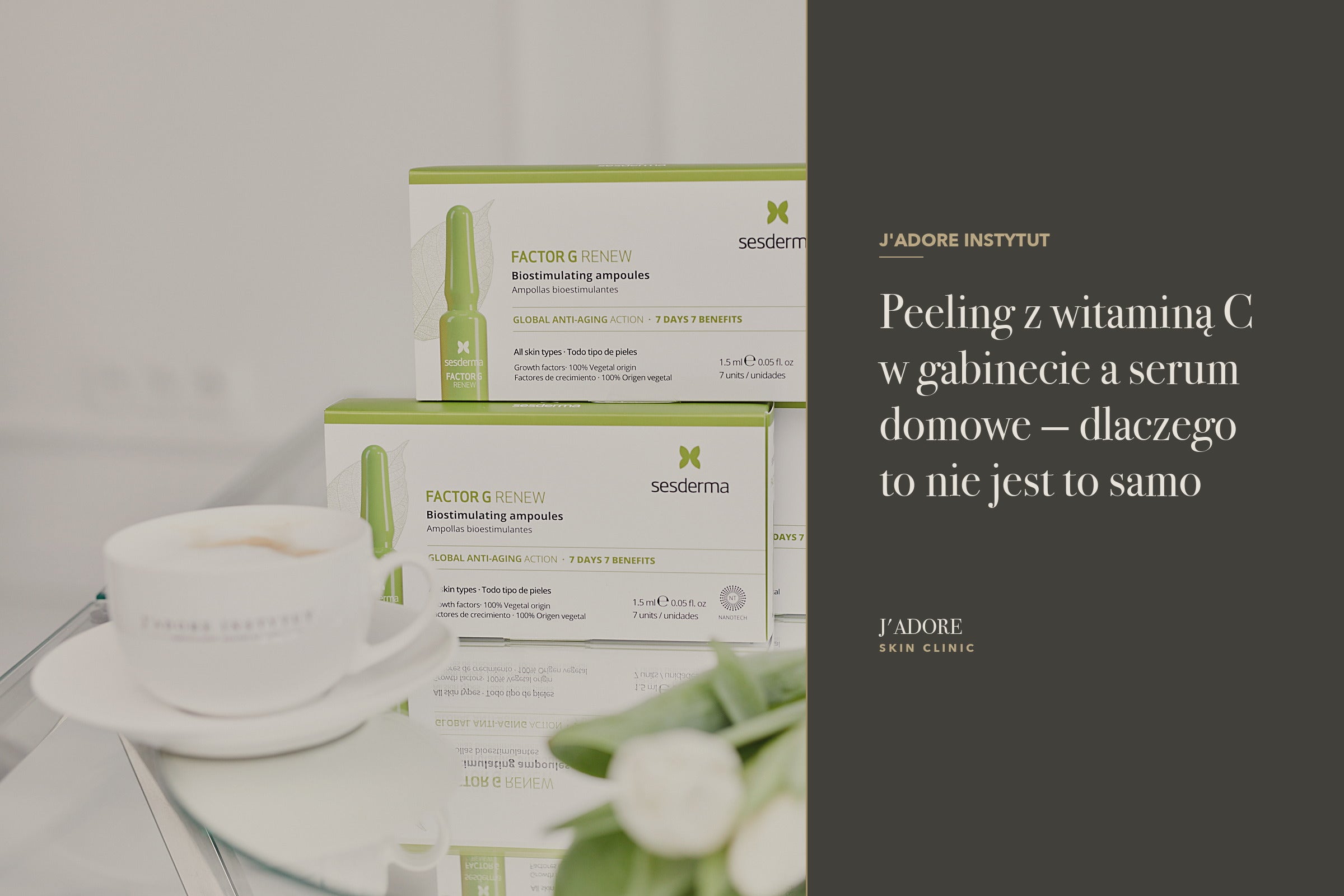
“I have a vitamin C serum at home” — this is a sentence that cosmetologists hear very often. And they respond: great, use it. But that doesn’t mean that the vitamin C peeling in the clinic and the home serum do the same thing. They share a common denominator — vitamin C — but almost everything else differs: the form of the molecule, concentration, depth of penetration, pH of the preparation, and thus the effect and mode of action. This is not a criticism of either solution. Both make sense — but in different situations and roles. The serum works on the surface, regularly, preventively. The clinic peeling can reach deeper, works intensively and therefore requires specialist supervision. If you treat them as substitutes, you may not be fully benefiting from either of them. In this text, we break down vitamin C into molecules — literally.
Vitamin C — one name, many faces
Before we compare the clinic with home use, we need to understand one thing that the cosmetic industry carefully hides behind an elegant label: “vitamin C” is not one ingredient. It is a whole family of compounds — some stable, others requiring precise conditions, some active immediately, others requiring enzymatic transformation in the skin. And which form the preparation contains determines what actually reaches the cells.
- L-ascorbic acid — pure, biologically active form of vitamin C. It acts directly, but is extremely sensitive: it oxidizes under the influence of air, light, and water, changes color to yellow or brown, and its activity decreases quickly after opening the package. In home cosmetics, it is difficult to stabilize — which is why many “vitamin C serums” simply do not contain it in an active form.
- Vitamin C derivatives (e.g., ascorbyl glucoside, ascorbyl phosphates) — much more stable, easier to encapsulate in creams or serums, which is why they dominate in home care cosmetics. Before they can act like vitamin C, they must be enzymatically processed in the skin. The effectiveness depends on the efficiency of this process — and it varies among different people.
- Forms used in clinics (e.g., high-concentration buffered L-ascorbic acid) — here, concentrations and pH are precisely matched to the clinical effect. The preparation is prepared or opened just before the treatment, used by a specialist, and sometimes combined with methods that facilitate penetration. This is a completely different league of stability and potency.
A serum with L-ascorbic acid that has changed color from clear to yellow or orange has oxidized — vitamin C reacts with oxygen and loses its activity. This is not the fault of the brand or a “natural” effect. It is a sign that the preparation has stopped working as it should. If your serum has changed color — it’s time for a new one.
What pH Does, or Why Acidity Is Not a Detail
L-ascorbic acid — the most active form of vitamin C — is unstable not only to air and light. Its action is strictly related to the pH of the preparation. In an overly alkaline environment, it loses activity almost immediately. In a very acidic environment — it is strongly active, but the skin may not tolerate it without preparation.
Typical home care serums balance between effectiveness and safety: the pH is chosen so that it can be used daily without irritation, on unprepared skin, of various types and sensitivities. The side effect of this compromise is limited concentration and penetration strength — intentionally.
The clinic preparation does not have to make this compromise in the same way. The specialist knows your skin, can prepare it appropriately, controls the exposure time, and reacts in real-time to what they see. That’s why they can work with parameters that a home user should not apply themselves — and not because they are less advanced, but because they do not have professional supervision.
L-ascorbic acid is most active at low pH (acidic). The higher the pH of the preparation, the faster vitamin C loses activity. That’s why preparations with pure vitamin C have an acidic reaction — and that’s why they can sting, especially on sensitive skin. A well-formulated home serum balances acidity so that it can be used daily. A clinic treatment can work in a different range — controlled by a specialist.
Depth of Penetration — Where Vitamin C Reaches
The skin is not a tissue paper. It has its own defense mechanism that guards what passes through it — and it does this very effectively. The epidermis acts as a barrier: it allows small and lipophilic (fat-loving) molecules to pass through, while it hydrophobizes large and hydrophilic ones. Vitamin C, being a hydrophilic (water-loving) molecule, has limited permeability through this barrier.
In home serums, this barrier is overcome with moderation — that is precisely their role. The preparation works mainly in the epidermis and the upper layers of the dermis: it smooths, hydrates, evens out skin tone, inhibits melanin production, and acts as an antioxidant. These are valuable effects that are very visible to many people with regular use.
The clinic peeling with vitamin C can reach deeper — depending on the formula and method. Controlled exfoliation of the epidermis temporarily removes part of this barrier, allowing active ingredients to reach deeper and work where the serum does not reach under normal conditions. Hence the different quality of the effect — and hence the necessity for specialist care.
The epidermal barrier is not a flaw in the system — it is a precise protective mechanism that protects us from the penetration of microorganisms, chemicals, and toxins. Cosmetics that “break through the barrier” more strongly are more effective — but also require caution. That’s why acid peels used without control can lead to irritation or hypersensitivity, while the same ingredient in the hands of a specialist can lead to a clear improvement in skin condition.
Vitamin Peeling in the Clinic — What Actually Happens
A vitamin C peeling in the clinic is not just “a stronger serum applied by a specialist.” It is a planned, multi-step procedure with a specific logic — and each step matters.
Note. A clinic acid peel — even a gentle one — can cause temporary redness, sun sensitivity, and skin peeling in the following days. This is not a side effect, but a planned skin reaction. After the treatment, sun protection is mandatory, not optional. Specific indications and possible contraindications (e.g., pregnancy, active inflammatory states, taking photosensitizing medications) are always determined individually by the specialist.
Home Serum — Where Is Its Place
After all this, it would be easy to draw the conclusion: “since the clinic is more effective, the serum makes no sense.” That would be a mistake. The vitamin C serum has its undeniable place — only it is different from the clinic, and in a different logic of time.
The clinic works intensively, but episodically. Peeling is done once in a while. Between visits, the skin needs daily care that maintains the effects, protects, and supports. A vitamin C serum used regularly — in the morning, under sunscreen — works preventively: it inhibits the formation of pigmentation under the influence of the sun, neutralizes free radicals, supports the barrier. This is the continuous work that no clinic treatment can replace, as you cannot do peeling every day.
If you want your home serum to work more effectively: apply it to clean, slightly damp skin (not wet), wait a moment before applying the next step, and always finish with SPF in the morning. Vitamin C and the sun are a duo that works together — vitamin C neutralizes free radicals, SPF prevents their formation. Without a filter, part of its work is wasted.
How These Two Worlds Play Together
The most sensible approach is not to ask “clinic or serum,” but to design a routine in which both have their roles. The specialist in the clinic can periodically reset the skin — remove accumulated pigmentation, stimulate it to renew, improve uniformity and tension. Good home care prolongs these effects and works in the background throughout all the days between visits.
There is also one practical conclusion that is rarely mentioned: after a clinic treatment, the skin is often better prepared to absorb active ingredients from home cosmetics. The epidermis is renewed, the barrier has functioned differently for a short time — and this means that serum applied in the evening after returning home (as recommended by the cosmetologist) can penetrate more effectively and give a better effect than under normal conditions. This is not a coincidence — it is a planned synergy.
You leave the clinic with a slightly warmed face — the specialist has already applied a soothing cream. They say: for the next two days, gentle care, no acids, no retinol, but sunscreen in the morning is mandatory. And from the third day, you can return to the serum — you will see that it absorbs differently. And they are right. The skin after peeling is like good paper — it is more willing to accept what you apply to it.
How to Be Sure That the Serum Really Works
This is a question many people ask themselves who consistently use vitamin C for months — and are not sure if anything is happening. The answer is not obvious: vitamin C in home care often works preventively more than correctively. This means that the effect of its action may be not so much a clear brightening, but rather a lack of new pigmentation, slower photoaging, better skin tone. These are effects that are hard to “see” — because it’s about what is NOT there, not what has been added.
If you care about more tangible, quicker changes — evening out existing pigmentation, improving texture, visible brightening — this is where the clinic comes in. An acid peel with vitamin C can yield effects that a home serum will not achieve in a reasonable time, or will not achieve at all — because it simply is not a tool for that job. Just as an electric toothbrush is great for daily teeth cleaning, but sandblasting in a dental office does something different.
Pure L-ascorbic acid in a good serum is one of the few substances for which the scientific literature is really solid — studies confirm its antioxidant action, inhibition of melanogenesis, and support for collagen synthesis. The problem? Most cheap serums contain such low concentrations or such unstable forms that the clinical effect is questionable. It’s worth reading the ingredients — and not buying based on the color of the packaging.


