

There is a paradox that almost everyone with oily skin knows: the more you try to degrease it, the more sebum it produces. Soap after soap, toner after toner, mattifying gel, oil-absorbing papers — and the effect is the opposite of what you intended. The skin shines again after just an hour. This is not a matter of bad will or an improper diet. It is a specific biological mechanism — the rebound sebum effect — and it works reliably every time the sebaceous gland feels that the skin is too dry. Understanding this mechanism is the first step to stop fighting your own skin and start guiding it. In this article, we break down what happens in the sebaceous gland when we use overly aggressive skincare — and explain why oily skin needs hydration more than is commonly believed.
Sebaceous gland — a small factory with an alarm system
To understand the rebound sebum effect, it is worth first seeing what the sebaceous gland is and why it produces sebum at all. It is a microscopic organ present almost all over the skin — particularly densely on the face, head, and chest. Its task is simple and evolutionarily ancient: to produce sebum that lubricates the skin and protects it from water loss, microorganisms, and mechanical damage.
Sebum is not just fat. It is a complex mixture — triglycerides, free fatty acids, squalene, waxes, and many other substances — that together build what specialists call the skin's hydrolipid barrier. It is a thin film on the surface of the skin that may not look attractive in the mirror, but serves a critical function: it is a tight cover that keeps water inside and aggressors outside.
Sebum is also food for the skin's probiotic bacteria, primarily of the genus Cutibacterium. The appropriate pH of the environment created by sebum acts as a chemical barrier against pathogens. When there is too much — a problem arises. When there is too little — the skin loses protection against infections. Just like in the intestines: it’s about balance, not sterility.
The sebaceous gland has its own fat level sensor — it actually responds to signals from several sources at once: hormones, autonomic nerves, and — crucial for our topic — the state of the lipid layer on the surface of the skin. When this layer is washed away, worn down, or dissolved, the sensor registers: "too dry, too little protection". And it kicks production into higher gear.
What is the rebound sebum effect and where does it come from
The rebound sebum effect (in English: rebound sebum effect) is a compensatory response of the sebaceous glands to the sudden removal of natural fat from the skin's surface. In practice, it looks like this: you use an aggressive cleansing or mattifying agent → the skin loses its lipid layer → sensors register a deficit → glands produce more sebum than before washing → the skin shines more than before.
This vicious cycle is particularly well observed in people who have switched to a very aggressive cleansing routine — several times a day, with a strong surfactant or with an alcohol-based toner after washing. The skin stops producing a "normal" amount of sebum because its glands get used to constant stimulation. The baseline level of sebum production can increase permanently if this cycle is maintained for years.
This is one of the biggest skincare myths: oily skin does not need hydration. In reality, oily skin often shows signs of dehydration — TEWL (transepidermal water loss) is elevated because the damaged lipid barrier does not hold water tightly enough. The effect? Glands work at full capacity, but the skin is simultaneously dull and tight after washing, and oily by evening. Oily and thirsty at the same time — and neither of these problems is "made up".
What to avoid, and what really changes the game
Knowing how the rebound sebum mechanism works, it is easy to compile a list of mistakes that drive it. This is not about moralizing — most of these habits are the result of logical thinking: the skin is oily, so it needs to be degreased. The problem is that this logic works against biology.
Niacinamide (vitamin B3) in a concentration of 2–4% in toners or serums can limit sebum secretion and reduce the visibility of pores for many people. The mechanism? It inhibits the transfer of melanosomes (side effect: evening out skin tone) and reduces the activity of sebaceous glands by modulating local mediators. It does not mechanically remove sebum — it works from the inside. This is a fundamental difference compared to mattifying tissues.
The key change in thinking is this: oily skin does not need more fighting — it needs less aggression and more barrier. When the gland stops defending itself against attack, it gradually lowers the baseline sebum production to its natural level. This process takes — for many people from 4 to 8 weeks. During this time, the skin may look worse before it starts to look better. This is ordinary physiology, not a reason to panic.
Hormones, stress, and other variables worth knowing
Skincare is not the only lever controlling sebum production. Sebaceous glands have receptors for several groups of hormones — and it is this sensitivity that explains why the skin changes cyclically, depending on the phase of the menstrual cycle, stress levels, or life stage.
- Androgens (DHT, testosterone). The main biological drive of sebaceous glands. The higher the level of androgens, the greater the activity of the glands. This is why in teenagers (hormonal boom) seborrhea is so strong, and in women after menopause, the skin often becomes drier on its own.
- Cortisol (stress). Stress raises cortisol levels, which indirectly stimulates sebaceous glands. That’s why during intense periods (deadlines, little sleep, strong emotions) oily skin is often oilier than usual — even with unchanged skincare.
- Insulin and diet. High-glycemic diets and dairy products can elevate the level of insulin-like growth factor (IGF-1) in some people, which stimulates sebaceous glands. This is not a universal rule, but a correlation visible in many studies.
- Menstrual cycle. An increase in progesterone in the luteal phase (about 2 weeks before menstruation) often exacerbates seborrhea and promotes the formation of comedones. This is not a myth — it’s physiology that cannot be "waited out" without considering the cycle in skincare.
When seborrhea is very severe, does not respond to skincare modifications, or is accompanied by cystic acne, irregular cycles, excessive hair growth, or other hormonal symptoms — it is worth consulting a dermatologist or endocrinologist. Some cases require systemic treatment (e.g., isotretinoin, spironolactone, anti-androgenic contraceptive pills), and the beauty salon is then a complement to therapy, not its center.
This is an important context for any oily skin care: you can optimize skincare as well as possible — and still have oily skin, if hormones or strong, chronic stress are responsible for the oiliness. A cosmetic cannot replace diagnostics.
What happens in the office — and why these are different tools than in the bathroom
Home care can break the vicious cycle of the rebound effect and stabilize the skin — but it has its limitations. When sebaceous glands are chronically overactive, comedones are deeply lodged, and the skin texture has changed (enlarged pores, unevenness, post-inflammatory hyperpigmentation), tools that work deeper and more precisely than a cream are needed.
If you know that feeling: washed and "ready" in the morning, by eleven oil papers, in the afternoon again oily — it is not a matter of willpower or more frequent washing. It’s the sebaceous glands working in a compensatory loop that you maintain with every wash. Resetting this loop often requires more than just changing the gel — it requires time, patience, and sometimes support from the outside.
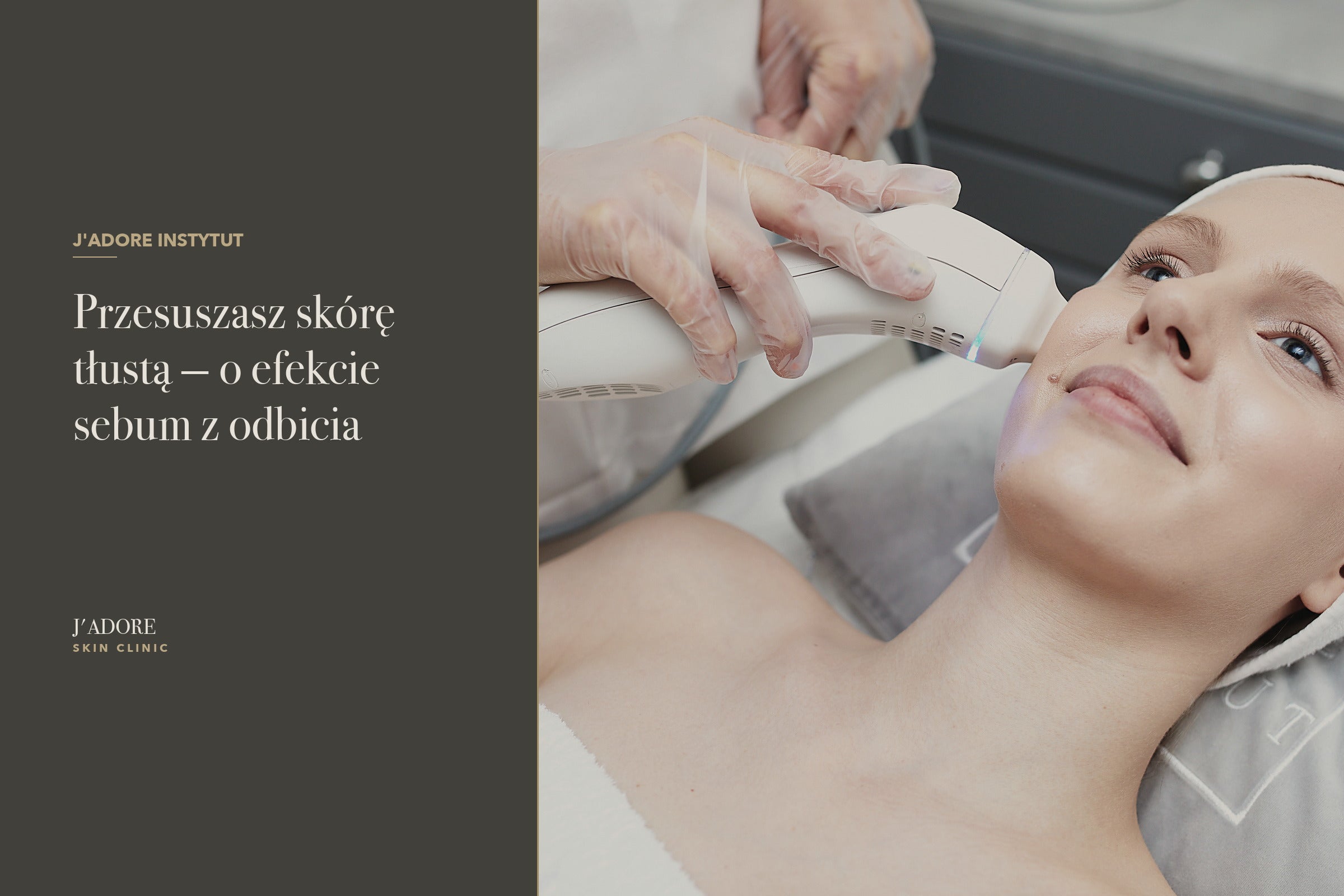
In the office, we work with oily skin differently than at home: not by degreasing, but by normalizing and regulating from within. Treatments can reduce the activity of sebaceous glands, cleanse pores of trapped sebum and dead skin, support the skin barrier, and improve its texture — so that home care can work more effectively. Below we have gathered treatments that bring visible results for many people with oily and combination skin.
A typical protocol for oily skin with the rebound effect is a series of treatments spread over time (not a one-time "everything" treatment). The first effects of sebum regulation may be visible after 2–3 treatments, and skin stabilization — after several weeks of consistent, gentle home care conducted in parallel.


