

Your bathroom shelf is bending under the weight of serums, toners, essences, and ampoules — and your skin is still doing what it wants? Summer is the perfect time to take a breath. And let your skin breathe. Because in skincare, especially summer skincare, less really means more.
Overconsumption in skincare — how did we get here?
Do you remember the times when skincare was just Nivea cream and makeup remover? Then came the Korean boom of multi-step routines, Instagram full of #shelfies, and suddenly it turned out that you need twelve steps to look like someone who "just takes care of themselves".
The global skincare industry is projected to reach a value of 189 billion dollars by 2025. The average European woman has 6–8 facial care products at the same time. Influencers promote routines worth several thousand zlotys a month. And dermatologists are increasingly seeing in their offices a phenomenon they call “overcosmeting” — irritated, sensitive, and confused skin due to an excess of active ingredients.
The backlash was just a matter of time. And it came — from Korea, where the problem originally arose.
Skip care — a Korean return to roots
The skip care trend was born in Seoul around 2023 as a response to absurdly elaborate routines. The philosophy is simple: instead of layering products one on top of the other, choose a few truly effective ones and let your skin work on its own.
Physiology speaks for itself — in summer, your skin is naturally in better condition than in winter.
- In the heat, sebaceous glands work harder — you produce more sebum, so the natural lipid barrier is stronger
- Higher humidity levels (60–80% in summer vs 30–40% in winter in heated rooms) mean that the skin loses less transepidermal water
- More vitamin D from sun exposure can support regeneration processes
- Sweat is a natural NMF (natural moisturizing factor) — it contains urea, lactates, and amino acids that hydrate the skin from within
Your skin doesn’t need rescuing in summer. It needs protection and peace.
The big cut — what to throw out of your summer routine
Before we move on to what stays, let’s talk about what gets tossed overboard. No sentimentality.
Did you apply jojoba oil under your cream in winter? Great move — then. In summer, occlusion acts like cling film on skin that is already producing more sebum. The effect? Clogged pores, blackheads, and in the worst case — heat rash. If your skin is dry even in summer, a light emulsion will be sufficient.
Retinol itself is not photosensitizing — it does not absorb UV and does not directly increase sensitivity to the sun. BUT: retinol accelerates cell turnover, revealing younger, thinner skin that may be more susceptible to UV damage. If you have been using retinol for months and apply SPF 50 daily — continue. But if you plan to start — it’s worth waiting until September.
Glycolic, salicylic, mandelic acid — all increase photosensitivity. You don’t have to eliminate them completely, but limit to one use per week instead of three. And always in the evening. The skin naturally exfoliates faster in summer due to sweating and higher turnover — it doesn’t need additional chemical help.
Layering five serums is a winter sport. In summer, each additional layer is an extra barrier between the skin and SPF (which should sit on clean, hydrated skin). One serum. Period.
4 products that stay — and why these
Morning and evening. In summer, you wash your face more often (sweat, SPF to remove), so the product must be gentle. Look for: pH 5.5 (physiological skin pH, does not disrupt the barrier), SLS/SLES-free (sulfates strip lipids too aggressively), gel or foam formulas (lighter than milk). Double cleansing in the evening (micellar oil + gel) makes sense with mineral filter SPFs — they are harder to remove. This is the only exception to the minimalism rule.
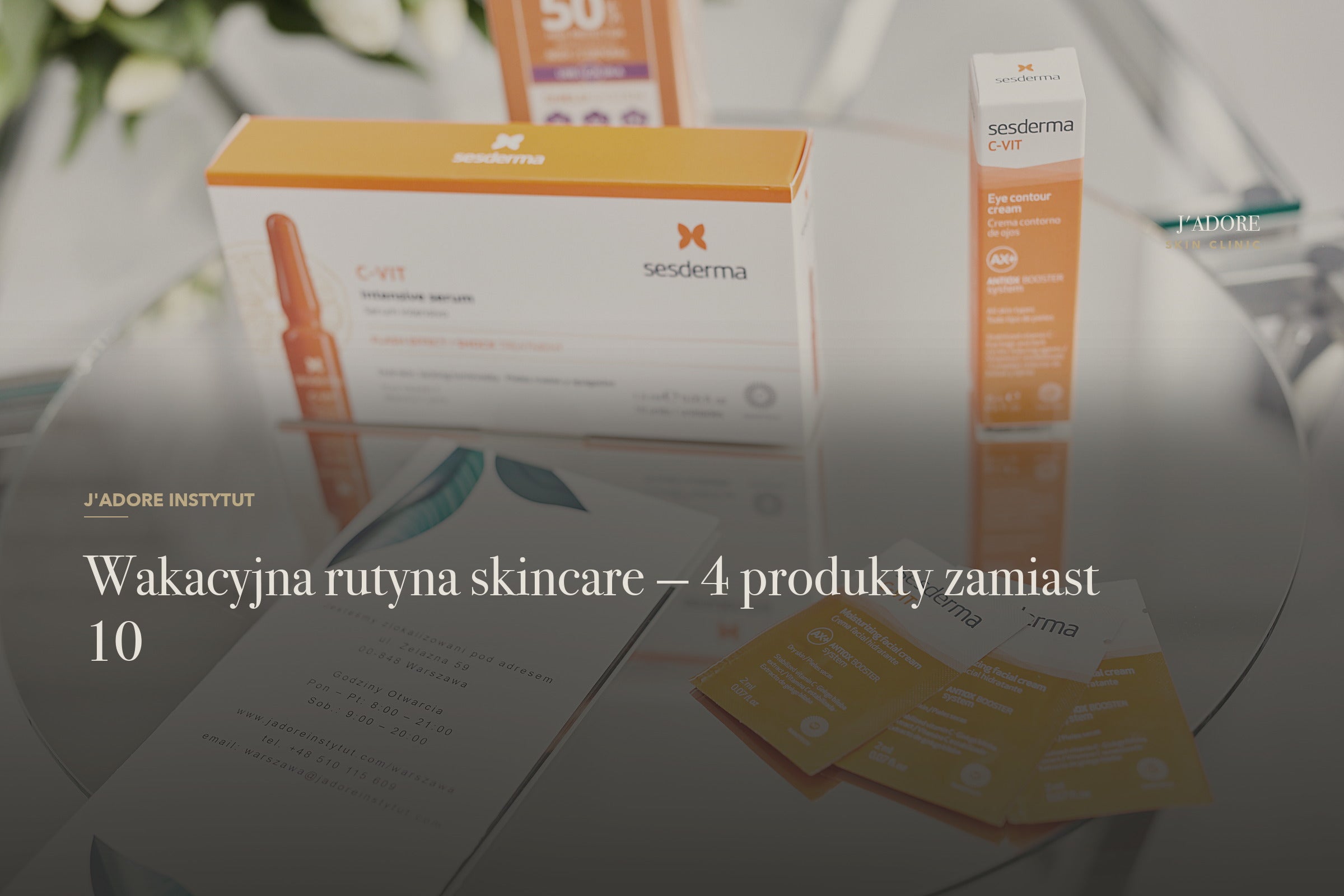
Vitamin C (L-ascorbic acid, 10–20%) is the summer MVP. It neutralizes free radicals generated by UV and works synergistically with SPF — studies show that the combination of vitamin C + SPF can provide significantly better protection against photoaging than the filter alone. Additionally, it can lighten hyperpigmentation (and new ones form in summer) and support collagen synthesis. Apply in the morning, on clean skin, before SPF. Allow 2–3 minutes for absorption.
This is non-negotiable. SPF is the only product that has been scientifically proven in long-term studies to help prevent photoaging. Beware of traps: foundation with SPF 30 does not protect like SPF 30 (to achieve the declared protection, you would have to apply many times more product); apply 1/4 teaspoon to the face; reapply every 2 hours when exposed to the sun. In summer, a light fluid or gel-cream is more convenient than thick creams with a white cast.
In the evening, after cleansing, one layer of a light emulsion or gel cream. Look for: ceramides (repair the lipid barrier damaged by sun and wind), low molecular weight hyaluronic acid (binds water in deeper layers), niacinamide (regulates sebum, strengthens the barrier, reduces redness), panthenol (soothing, anti-inflammatory). Avoid paraffin occlusives, heavy butters, and rich plant oils (argan, avocado) — these are winter ingredients.
Sample routine — 5 minutes in the morning, 5 in the evening
1. Cleansing gel → 30 seconds of massage, rinse with lukewarm water 2. Vitamin C serum → 3–4 drops, pat in 3. SPF 50 → 1/4 teaspoon, spread evenly
1. Cleansing (double, if makeup/mineral SPF) 2. Lightweight moisturizer → thin layer on damp skin
That’s it. No toners, essences, masks, ampoules. The skin doesn’t need ten steps — it needs four good products and consistency.
What about the rest of the body?
Summer minimalism also applies to the body:
- SPF cream for the décolletage, shoulders, and hands — these areas can age the fastest
- Light balm after bathing — on damp skin, once a day
- Lips with SPF — the most often neglected and most often burned area
When minimalism is not enough
Four products may be enough for many people in summer. But if you have active acne, rosacea, eczema, or melasma — do not give up specialized care without consulting a dermatologist or experienced cosmetologist. Minimalism is a philosophy for healthy skin, not a substitute for treatment.
In summer, the skin often clearly communicates what it needs — and most often it needs you to let go. If you want to start summer with a clean slate and choose these four products precisely for your skin, schedule a cosmetic consultation at J'ADORE INSTYTUT — in Warsaw on Żelazna or Mińska or in Kraków on Karmelicka.


